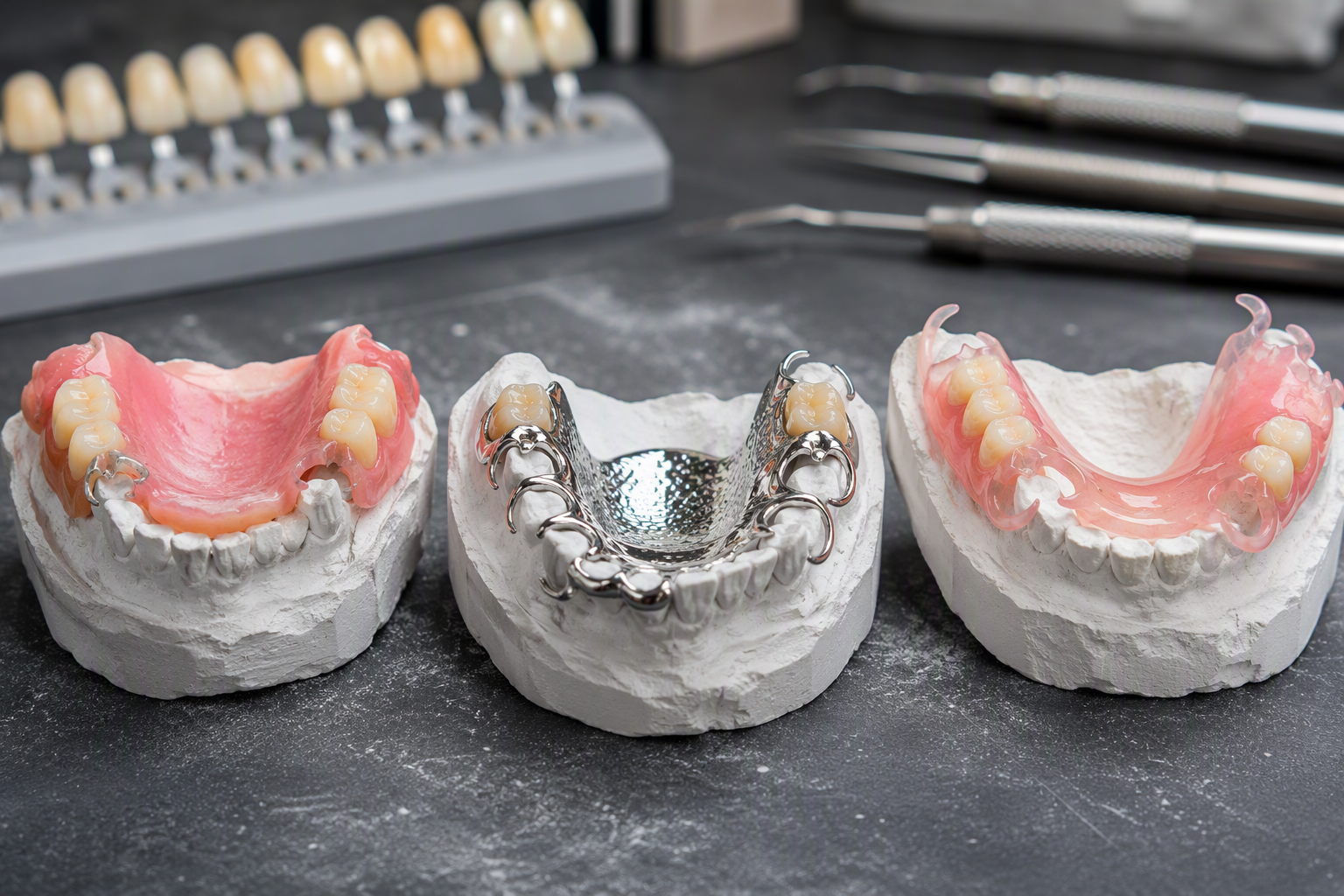
Removable partial dentures differ significantly by material, retention mechanism, and structural support. One common option uses an all-acrylic base. Another combines a rigid cast metal framework with acrylic sections and replacement teeth. The third is molded from flexible thermoplastic resin. Each has its own marketing vocabulary, and reading past it is most of the work.
No single material leads in every category, so sequence matters more than the shortlist. A practice must establish which designs your mouth can support before appearance or budget narrows the field. That is the exact sequence Comprehensive Dental follows when planning partial dentures Las Vegas: the pattern of missing teeth and health of adjacent anchor teeth rule out candidates first, ensuring you choose only options clinically suited to your mouth.
Acrylic partial dentures
An acrylic partial uses a gum-colored acrylic base holding the replacement teeth, usually with thin wire clasps bent to grip the neighboring natural teeth. The base itself does much of the supporting work, so it needs enough coverage across the gums and palate to spread the load. That coverage is why patients notice acrylic partials more in the first weeks, especially against the roof of the mouth.
Acrylic earns its place when the mouth is still changing. If a molar is questionable and may come out within a year, an acrylic base can usually have a tooth added in the laboratory instead of being replaced outright, and fracture repair is often straightforward. That same base can be bulkier and generally less durable than metal alternatives.
Cheap and disposable are not the same thing. A well-made acrylic partial is a real appliance, not a placeholder.
Acrylic is often used as a temporary, affordable option because the laboratory work is simpler and the appliance can be modified later. Don’t assume that automatically makes it the cheapest choice. The fee depends on the number of teeth being replaced and any preparatory treatment you need first, and your dentist still has to confirm that the remaining teeth can support the clasps and that your bite won’t overload the base.
Cast metal frameworks
A cast metal removable partial uses a cobalt-chromium framework with acrylic sections and replacement teeth attached where teeth are missing. Because the alloy is rigid, the framework can be made far thinner than an all-acrylic base, and chewing load can be routed through rests seated on prepared surfaces of the natural teeth rather than pressed straight into the gum tissue.
Metal can sometimes show. A clasp arm has to sit where retention exists rather than where it would be least conspicuous, and on an upper premolar high in the smile line, that can mean a visible line of alloy when you talk.
Repairs depend on what breaks. An acrylic section or a loosened replacement tooth can often be repaired, while a fractured framework arm may need laboratory soldering or a new casting. Cast metal also needs suitable supporting teeth, and loose teeth or untreated gum disease can rule the design out until that treatment is finished.
A cast metal partial can be worth its higher price when you’re clinically suited to a thin, rigid framework, and you want a definitive appliance rather than an interim one. Longevity, though, isn’t bought with the framework. It depends on fit and design. It also depends on whether the supporting teeth stay healthy and whether you maintain daily plaque control and keep up with follow-up visits.
Flexible thermoplastic partials
Flexible partials are molded from pliable thermoplastic resin instead of a rigid base. Some designs use tissue-colored clasps that wrap the necks of the natural teeth and resemble gum rather than metal at conversational distance. Patients often describe the appliance as light.
Flexibility isn’t support, though. Relining a flexible appliance can be difficult. So can adding a tooth later, and some products won’t accept a chairside adjustment the way acrylic will.
Product properties vary too. High-performance thermoplastic brands like Valplast® (nylon-based) and TCS® (polyolefin-based) exhibit different flexibility and adjustment profiles. Furthermore, combination/hybrid partials—which integrate a rigid cast metal framework with flexible, tissue-colored clasps—can provide metal’s structural support with the visual appeal of flexible designs. Ask which resin is proposed for you and what its manufacturer documents.
| Material | Typical strengths | Common limitations | Appearance | Modification and repair | Often considered for |
|---|---|---|---|---|---|
| Acrylic | Lower initial cost in many cases; easier to modify during oral changes | Bulkier base; may fracture or wear sooner | Gum-colored base, but wire clasps may show | Teeth can usually be added; repairs often straightforward | Interim treatment and tighter budgets |
| Cast metal | Thin rigid framework; chewing load routed to the teeth | Higher initial price; requires suitable supporting teeth | Replacement teeth look natural, but clasp visibility varies | Options depend on the framework and the damage | Definitive long-term treatment |
| Flexible thermoplastic | Thin, lightweight, and pliable; gum-colored clasps instead of visible metal | Difficult to reline or modify; product properties vary | Often chosen for comfort and natural appearance | Repair and modification options vary by resin | Selected for appearance or comfort priorities |
These are general tendencies. None of them is a promise about what will suit you or what it will cost.
What Your Remaining Teeth Can Carry
A removable partial depends on what’s left in the arch. The position of your remaining teeth decides where clasps and rests can go, and their gum health and crown shape decide whether those contacts will hold up. Treat gum disease and decay before planning an appliance around a tooth that may not survive the decade. Large restorations change what a restoration can be seated on, and an uneven bite can load one side harder than the other, which may later surface as a sore spot under the base.
Support describes how far the appliance presses toward your gums under a bite. It’s a question of what carries the load: tooth or tissue.
Retention is what resists lifting, and clasps plus the close fit of the base do that job when you pull on a piece of bread.
Stability limits side-to-side rocking. A rigid framework spanning both sides of the arch usually rocks less than a plate that flexes under pressure.
Design quality shows up over years, not at delivery. Long-term success relies heavily on ongoing maintenance, bite alignment, and consistent oral hygiene, not framework material alone.
Visible clasps and appearance priorities
No removable appliance can be guaranteed to have retention components you’ll never see. Patients asking about partial dentures without visible clasps are usually asking about metal at the front of the smile, and that can often be improved. Improved, yes. Eliminated, no. A framework described as invisible in the mouth won’t be, not for a patient with a wide smile and a short upper lip.
Tissue-colored clasps on a flexible partial are less conspicuous rather than invisible, because at close range someone can still see where the resin crosses the tooth. A cast metal design can sometimes place a clasp behind the smile line or tuck a rest into a groove. How well either approach works depends on your smile line and tooth position. Gum color matters, and so does how much retention the appliance needs to stay seated through a meal.
On appearance alone, flexible has the edge over acrylic, especially when a wire clasp would otherwise sit high on a canine.
Two patients with identical gaps can reasonably end up with different appliances.
Price and Lifespan Change the Value Calculation
What published costs include
National dental fee surveys estimate the average cost for a single-arch removable partial denture generally ranges from $1,500 to $2,500, depending on whether you choose an acrylic base, flexible resin, or cast metal framework. An average is not a quote. Individual quotes may differ substantially.
Ask what your number covers. Impressions or scans and laboratory charges usually fall under it. The examination and imaging may not. Any extraction or treatment for decay or gum disease is often billed separately, as are adjustments after delivery. The same appliance can also carry different prices in different local markets.
A treatment plan showing one line for “partial denture” is worth a second conversation before you sign it. Case-specific figures on pricing and insurance coverage come out of a consultation, not a published range.
Cast metal partial denture cost
Cast metal partial denture cost generally sits above resin, and the gap between the two averages a few hundred dollars. Read it as a broad tendency rather than a fixed surcharge for the alloy, because what you’re quoted reflects the laboratory work your own case requires.
A higher fee at delivery can still be the better long-term value if the framework stays stable, comfortable, and serviceable for years. No alloy or resin can stop your gums from remodeling or a supporting tooth from failing.
Separate the appliance fee from the preparatory dentistry before you compare two quotes.
How long acrylic and other partials can last
“How long do acrylic partial dentures last?” is the most common question, and people want a single number. Clinical studies show that removable partial dentures typically have a functional lifespan of 5 to 10 years, depending on material selection, tissue changes, and oral hygiene.
Nobody should promise you that every acrylic appliance runs five to seven years while every cast metal one clears 10. That comparison needs a stronger source than either camp’s brochure.
Replacement usually gets triggered by an event rather than by a birthday. A cracked base or badly worn replacement teeth can end an appliance’s service life. So can a base that no longer matches the ridge beneath it, or the loss of a supporting tooth that carried a clasp.
What “Healthy” Means in a Partial Denture
The healthiest material depends on fit and hygiene
No single partial denture material is healthiest for every patient. A well-designed appliance in a suitable dental material is healthier than a poorly fitting alternative, because fit does more work here than the material name. So does how thoroughly you clean around the clasps. A base pressing on tissue it shouldn’t, or a clasp loading a tooth harder than that tooth can take, causes more trouble than the choice between an alloy and a resin.
Metal sensitivity deserves a careful conversation, not a verdict. Cobalt-chromium is a long-established dental alloy with generally good cytocompatibility, though it can rarely cause sensitization, irritation, or allergic reactions. If you have a documented reaction to a metal or a resin, bring that record to the consultation and ask for the material composition of anything being proposed.
Distinction between removable and fixed options
Note that a “fixed partial denture” refers strictly to a non-removable dental bridge cemented onto natural teeth or implants. While fixed bridges utilize materials like zirconia or ceramic, they represent a distinct treatment category separate from removable partial appliances.
Questions to Ask Before Approving Treatment
A useful treatment plan describes a design, not a material label. It names the teeth carrying rests and the places the clasps will sit. It also says how thick the base or framework will be, and what happens if another tooth is lost. If the plan reads “flexible partial, upper” and stops there, you don’t yet have enough information to consent to treatment.
Take these to the consultation:
- Which materials are clinically suitable for my pattern of missing teeth, and which are not?
- How will the appliance be supported by my remaining teeth and gums?
- Where will the clasps sit, and will any show when I talk?
- Is this intended as a temporary appliance or a definitive long-term design?
- Can it be relined or repaired if I lose another tooth?
- What lifespan is realistic in my case, and what could shorten it?
- Which charges are included in the quoted fee, and which require insurance preauthorization?
- What fixed or implant-supported alternatives are clinically possible?
Your dentist should be able to explain why the proposed design suits your mouth specifically. Price and appearance shouldn’t be the only reasons they offer.
Cleaning Requirements Vary by Design
Cleaning acrylic bases and replacement teeth
How you clean a partial depends on what the appliance is made of, though the handling rules don’t change. Work over a folded towel or a basin of water so a dropped appliance lands on something soft. Rinse it after eating when that’s practical, and brush it daily with a soft brush and a product intended for its material.
Keep conventional toothpaste for your natural teeth.
Soaking is where patients improvise, and improvising can cost you an appliance. Confirm with your dentist or the laboratory that a particular cleanser is compatible with your base and its clasps, then follow the manufacturer’s directions on the container.
Protecting a metal framework
Ask your dentist or laboratory which product they recommend for the specific alloy in your framework, then stick with it.
The natural teeth supporting the appliance also need careful attention. Rests and clasp arms sit against enamel, and those contact areas trap debris, so plaque removal around a clasped premolar takes deliberate brushing and flossing, not a quick pass with a brush.
Flexible appliances need product-specific care
Cleaning and soaking directions vary by resin, so the instruction sheet that came with your partial takes priority over general denture advice.
A persistent odor can signal a problem. So can a hairline crack or a rough surface. A loose appliance belongs on the same list as tissue that stays sore.
What New Technology Can and Cannot Change
Intraoral scanning can replace putty impressions in many practices. Computer-aided design lets a laboratory draw a framework on screen, and milling or 3D printing can then produce it. These workflows can help a technician plan rest seats and clasp positions, and they can reproduce a design that already worked, which matters when an appliance must be remade after a fracture.
But “digital” doesn’t name a material. A printed resin partial and a milled framework are different objects with different mechanical properties, and a scan by itself doesn’t guarantee a better fit than a well-taken conventional impression.
Specific performance claims need specific evidence. If a practice tells you a printed or milled partial fits better or lasts longer than the conventional version, ask what that’s based on. A statement from a prosthodontic association carries weight, as does a peer-reviewed review or FDA documentation for the named device or resin.
Choose the Tradeoffs You Can Live With
The material selection ultimately depends on your oral health, long-term goals, and daily demands. Interim solutions for an evolving arch require different features than a definitive appliance built for long-term stability.
The right choice balances structural support, aesthetics, and long-term maintainability. Contact Elite Fix Denture today to schedule a personalized consultation and identify the ideal partial denture design for your smile.