GEORGE WASHINGTON’S TEETH
GEORGE WASHINGTON TEETH
The Complete Historical Truth: Wooden Teeth Myth, Slave Teeth, Hippo Ivory Dentures & Why Washington Lost All His Teeth
| 📌 | Quick Answer: George Washington did NOT have wooden teeth — that is a myth with no basis in evidence. His dentures were constructed from human teeth (some purchased from enslaved people), hippopotamus and elephant ivory, animal teeth, and metal. By his first presidential inauguration in 1789 he had only one natural tooth remaining. He suffered severe dental disease his entire adult life. |
George Washington’s teeth are one of the most searched topics in American history — and one of the most misrepresented. The myths are famous. The reality is historically important, scientifically documented, and far more compelling. This guide answers every major question: Did George Washington have wooden teeth? What were his dentures actually made of? Did Washington really use teeth from enslaved people? Why did he lose almost all his teeth? And what do his surviving dentures tell us about the man, his era, and the practice of dentistry in 18th-century America?
1. Did George Washington Have Wooden Teeth? The Myth Fully Debunked
GEORGE WASHINGTON TEETH
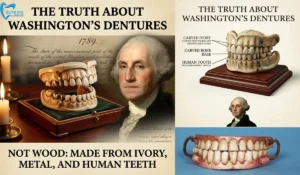
The most famous myth in American dental history asks: did George Washington have wooden teeth? Or more pointedly — did George Washington really have wooden teeth? Did George Washington wear wooden teeth? The answer, supported by every surviving piece of physical evidence, is emphatically no.
Washington’s actual dentures — several sets of which survive in museum collections and have been subjected to scientific analysis — show no trace of wood in any component. This should not be surprising: wood is a catastrophically poor material for dental prosthetics. It absorbs moisture and swells when wet, dries out and splinters when dry, provides no structural integrity under chewing pressure, and would rot within months in the warm, wet environment of a human mouth. No trained dentist of any era would construct dentures from wood.
The wooden teeth myth almost certainly originated in the decades following Washington’s death in 1799, developing through oral tradition and popular storytelling. The most likely source of the confusion is the appearance of aged ivory. Hippopotamus and elephant ivory — which genuinely were used in Washington’s dentures — develops a yellowish, stained, grain-like appearance over time that can, to an untrained eye, superficially resemble weathered wood. Additionally, bone (also used in some colonial-era dental work) has a similar visual quality when old and dry. Somewhere in the retelling, ‘ivory-colored’ became ‘wood-colored’ became ‘wooden.’
By the 19th century, the wooden teeth story was established American folklore, appearing in popular histories and schoolbook accounts. The myth has proven remarkably durable despite being easily refuted by anyone who has actually looked at Washington’s surviving dentures.
| ✅ | Myth status: Fully debunked. Scientific analysis of Washington’s surviving denture sets confirms materials including human teeth, hippopotamus ivory, elephant ivory, horse and donkey teeth, and metal alloy — but no wood of any kind. The wooden teeth claim is not a simplification or an exaggeration; it is simply false. |
2. What Were George Washington’s Teeth Actually Made Of?
When researchers and historians answer the question of what George Washington’s teeth were made of — or what was George Washington’s teeth made out of — the answer involves a combination of materials standard for high-quality 18th-century prosthetic dentistry. His dentures were sophisticated, expensive, custom-crafted objects. What were George Washington’s teeth made from? Scientific analysis confirms the following:
| Material | Source / Origin | How It Was Used |
| Human teeth | Purchased from various sources, including enslaved people | Set as visible ‘tooth’ units in the denture plate |
| Hippopotamus ivory | African hippo tusks, imported | Carved base plates; some replacement tooth units |
| Elephant ivory | Elephant tusks | Base plates and carved tooth forms |
| Horse and donkey teeth | Animal sources | Replacement tooth units set into the base |
| Cow teeth | Animal sources | Replacement tooth units |
| Lead-tin metal alloy | Metal workshop | Structural base frame and spring connector between plates |
| Washington’s own extracted teeth | Retained after extractions | Incorporated into prostheses as they were removed |
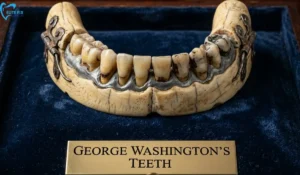
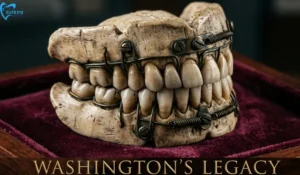
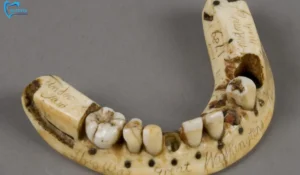
The most thoroughly documented and analyzed surviving example is the denture set made by John Greenwood around 1796, now housed at the Donald W. Reynolds Museum and Education Center at the Mount Vernon Estate. This set features a hippopotamus ivory base, with human and animal teeth set into it, connected by a spiral metal spring mechanism. The spring pushed the upper and lower plates apart, meaning Washington had to hold his jaw closed with constant muscular effort — a significant contributor to the tight-lipped, strained expression visible in his later portraits.
What did George Washington’s teeth look like? The surviving dentures are large, bulky objects. The carved ivory base was designed to press against Washington’s gums and fill out the facial contours that had collapsed after years of tooth loss. By modern standards they are crude; by 18th-century standards they represented advanced, expensive craftsmanship.
| 💡 | George Washington had hippo teeth — in the literal sense that hippopotamus ivory formed part of his dentures. Hippo ivory was prized in 18th-century dentistry for its density, hardness, and white color. When people ask ‘did George Washington have hippo teeth’ the historically accurate answer is yes: hippo ivory was a primary material in his dental prosthetics. |
You May Also Like: What Causes Gummy Smiles (And How They’re Treated)
3. George Washington Slave Teeth: The Documented History
GEORGE WASHINGTON TEETH
Among the most historically significant questions surrounding Washington’s dental history is whether he used teeth extracted from enslaved people. When people search ‘did George Washington have slave teeth,’ ‘George Washington teeth from slaves,’ ‘George Washington dentures slave teeth,’ or ‘did George Washington take teeth from slaves’ — they are asking about a documented historical reality, not a myth.
The Primary Source Evidence
Washington’s own household financial accounts, preserved and analyzed by historians, contain a payment entry from May 1784. The accounts record a payment described as being for ‘Negroes teeth.’ This entry was first brought to wide scholarly attention by Dr. Mary Thompson, a research historian at Mount Vernon, and was subsequently reported by the Philadelphia Inquirer in 2018 and covered broadly in historical scholarship.
The payment record places this transaction in the period when Washington was working with dentist Jean-Pierre Le Mayeur, a French practitioner then working in the American colonies who was known to purchase teeth from various people — including enslaved people — for use in dental prosthetics. The payment of six shillings, two pence, recorded in Washington’s accounts, aligns with what historians understand as compensation paid for tooth extractions.
The conclusion drawn by Mount Vernon’s own researchers — the institution with the deepest access to Washington’s primary source records — is that Washington purchased teeth from enslaved people at or near Mount Vernon, and that those teeth were almost certainly used in his dentures. The institution has addressed this directly in its public historical materials.
Why This Is Historically Important
George Washington’s slave teeth represent a specific, documented example of the ways in which enslaved people’s bodies were used to serve the needs of the people who enslaved them. Washington enslaved more than 300 people at Mount Vernon at the height of his slaveholding. The payment record shows that even Washington’s most intimate physical needs — the teeth in his own mouth — were met, in part, through transactions involving enslaved people who had very limited freedom to refuse.
The practice of purchasing teeth from poor and enslaved people was not unusual in 18th-century dentistry on either side of the Atlantic. Human teeth were a standard ingredient in quality dentures. But that historical context does not diminish the significance of Washington specifically purchasing teeth from people he enslaved. The juxtaposition — the founding father on the dollar bill, wearing teeth bought from his own enslaved workers — is a historically accurate image that has become more prominent in recent years as historians and institutions reckon with this history more directly.
| ⚠️ | Historical precision matters: some accounts have described Washington as ‘ripping teeth from slaves’ — the documented evidence suggests a financial transaction, not forcible extraction. The enslaved people were paid. But they were enslaved, which profoundly limits any meaningful notion of consent or refusal. The story is disturbing enough as documented history without embellishment. |
4. Why Did George Washington Lose His Teeth? The Full Medical History
Why did George Washington lose his teeth? Why did he lose all of his teeth? Why did George Washington start losing his teeth so young? These questions have documented answers rooted in disease, the limits of 18th-century medicine, and a cascade of dental problems that began when Washington was in his early 20s.
The Timeline of Washington’s Dental Decline
- Age 22 (1754): Washington notes his first tooth extraction in his diary. He is already experiencing serious dental problems as a young soldier.
- 1760s–1770s: Correspondence and diary entries document ongoing tooth pain, extractions, and orders for dental equipment including tooth powder and dental files. Washington was managing significant dental disease through his 30s.
- Early 1780s: During and after the Revolutionary War, Washington had lost most of his natural teeth and was managing with partial dentures. Dental pain was a known difficulty among those in his inner circle.
- 1789 — First Presidential Inauguration: Washington was inaugurated with only one natural tooth — a single lower left premolar. His other teeth had been replaced by dentures over the preceding years.
- 1796: John Greenwood extracted Washington’s last natural tooth, with Washington’s full agreement, and incorporated it into a new denture set. Greenwood kept the tooth as a personal memento afterward, set in a gold watch fob.
- 1799 — Washington’s Death: Washington died at 67 with no natural teeth remaining, entirely reliant on dentures for basic oral function.
Medical Causes of Washington’s Tooth Loss
- Chronic periodontal (gum) disease: The primary cause. Gum disease destroys the bone and connective tissue that anchor teeth, causing progressive loosening and eventual loss. In Washington’s era, there were no effective treatments — no antibiotics, no periodontal surgery, no deep cleaning. Gum disease was endemic among colonial Americans of all classes.
- Dental caries (cavities): The 18th-century American diet — particularly among wealthy households that consumed significant amounts of sugar and refined flour — was highly cariogenic. Without fillings or restorative dentistry, cavities progressed to pain and infection, resolved only by extraction.
- Smallpox at age 19 (1751): Washington contracted severe smallpox during a trip to Barbados. Serious systemic illness can accelerate dental decline, and some dental historians have suggested this contributed to his early tooth loss.
- Mercury (calomel) treatments: Washington, like many of his contemporaries, was treated with calomel (mercury chloride) for various illnesses throughout his life. Mercury is now known to be highly toxic to gum tissue and tooth enamel with prolonged exposure. The extent to which mercury treatments contributed to his dental decline is debated but is considered a plausible contributing factor.
- No restorative dentistry: In Washington’s era, there was no such thing as a filling in the modern sense, no local anesthesia, no ability to treat cavities before they became infections. Extraction was the only practical response to dental pain, and each extraction progressed the decline.
| 💡 | Washington was not unusual among his contemporaries in experiencing severe tooth loss — it was remarkably common in the 18th century. What distinguished him was the wealth to afford the most advanced prosthetic dentistry available in America, while most people simply went without. His dental situation illuminates the medical reality of the founding era. |
5. Washington’s Dentists and the Construction of His Dentures
Washington worked with several dentists over his lifetime. The most historically significant are documented here, along with their specific roles in his dental care.
| Dentist | Active Period | Role and Significance |
| John Baker | 1770s–1780s | Made early denture sets for Washington; designed appliances with ivory bases and human teeth; established the prosthetic approach Washington used throughout his life |
| Jean-Pierre Le Mayeur | Early 1780s | French dentist operating in colonial America; connected to the 1784 tooth-purchase transaction; made dentures during the period of the documented slave teeth payment |
| John Greenwood | 1790s | Washington’s most trusted and closely documented dentist; made the famous surviving 1796 denture set; maintained extensive correspondence with Washington about denture fit and care; extracted Washington’s last natural tooth and kept it for life |
John Greenwood’s relationship with Washington went beyond a typical patient-provider dynamic. Their surviving correspondence shows Washington describing dental discomfort in detail, sending his dentures to Greenwood for adjustments, and receiving written dental advice. When Greenwood extracted Washington’s last natural tooth in 1796, Washington gave it to him as a gift — an indication of the personal bond between the two men. Greenwood wore the tooth in a gold watch fob until his own death.
6. How Washington’s Teeth Affected His Appearance and Presidency
George Washington’s teeth — or rather, their absence and replacement with uncomfortable dentures — shaped his public image in measurable ways. George Washington’s teeth in his mouth were not a minor biographical detail; they influenced how he looked, how he spoke, and how he was portrayed.
The Dollar-Bill Portrait and Washington’s Appearance
The famous Athenaeum Portrait by Gilbert Stuart (1796) — the image that appears on the U.S. dollar bill — was painted specifically after Washington received a new set of dentures from John Greenwood. Stuart himself reportedly stuffed cotton padding into Washington’s mouth to fill out his sunken cheeks and create a more dignified appearance. The result is the slightly puffy, closed-lipped expression that has become the defining image of Washington.
People searching for ‘George Washington smiling with teeth’ will find that no authentic portrait shows him with an open-mouthed smile. This reflects both the formal conventions of 18th-century portraiture and Washington’s practical self-consciousness about his dentures. Washington’s ‘George Washington teeth smile’ was carefully controlled in public — a tight, closed expression that concealed the large, uncomfortable appliances in his mouth.
How the Dentures Shaped His Face
The spring-loaded denture mechanism — with coiled metal springs holding the upper and lower plates apart under constant tension — required Washington to exert continuous jaw muscle effort to keep his mouth closed. This created the characteristic jaw-clenched, slightly forward-jutting lower lip appearance visible in his later portraits. The ivory bases were also significantly larger than his natural teeth, pressing against his lips and cheeks and creating the rounded, somewhat swollen facial contour seen in the Stuart portraits and the Houdon sculpture.
Speech and Public Communication
Washington’s dentures affected his speech. He was notably careful in public address, speaking slowly and precisely — a trait often attributed solely to temperament but almost certainly reinforced by the practical difficulty of articulating clearly with ill-fitting dental appliances. Washington was famously terse in public settings, and his dental situation likely played a role in his preference for written communication and brief, carefully composed oral remarks.
You May Also Like: Sierra Ferrell Teeth: Natural Smile or Dental Work? (Truth Revealed)
7. The Surviving Dentures and Where to See Them
Several of Washington’s denture sets have survived into the present and are preserved in museum collections. They are among the most studied dental artifacts in American history.
Mount Vernon — The Primary Collection
The most significant and thoroughly documented surviving denture set is housed at the Donald W. Reynolds Museum and Education Center at Mount Vernon, Washington’s estate in Virginia. This is the set most researchers refer to when discussing what George Washington’s false teeth looked like, what they were made of, and how they functioned. Mount Vernon’s own researchers and historians have studied this set extensively and have published detailed accounts of its materials and construction.
Mount Vernon’s website provides the most authoritative public account of Washington’s dental history, including discussion of the slave teeth payment records. This is the primary scholarly source for this topic:
Authority Source: Mount Vernon — George Washington’s Teeth (mountvernon.org) — Primary source research from the Mount Vernon Estate & Museum historians
National Museum of Dentistry — Baltimore
The National Museum of Dentistry in Baltimore, affiliated with the University of Maryland School of Dentistry, also holds Washington-related dental artifacts and provides historical context for 18th-century American dental practice. Their collections and publications are an additional scholarly resource on this topic.
John Greenwood’s Legacy
Washington’s last natural tooth — extracted by Greenwood in 1796 — was kept by Greenwood in a gold watch fob for the rest of his life. After Greenwood’s death, the tooth passed through private hands. Its current location is documented in dental history records. This single tooth, more than any other artifact, symbolizes the intimacy of the Washington-Greenwood relationship and the remarkable arc of Washington’s lifetime of dental suffering.
8. 18th-Century Dental History: The World Washington Lived In
GEORGE WASHINGTON TEETH
Understanding George Washington’s teeth requires understanding what dentistry was — and was not — in his era. The dental world Washington inhabited was fundamentally different from the modern profession.
What 18th-Century Dentistry Could and Could Not Do
- No local anesthesia: Ether anesthesia was not introduced until 1846, nearly half a century after Washington’s death. Every extraction Washington underwent was performed fully awake, typically with the patient gripping the chair and the dentist bracing against the patient for leverage.
- No restorative fillings: The technology to drill and fill a cavity with durable material did not exist in practical form in Washington’s lifetime. A cavity meant eventual extraction.
- No X-rays: Diagnostic radiography was not available until 1895. Dentists worked entirely by visual inspection and patient-reported pain.
- No antibiotics: Dental infections could and did become systemic and life-threatening. Washington survived multiple dental infections that might have killed him with different luck.
The Human Tooth Market
In 18th-century Europe and America, human teeth were a commercial commodity used in denture construction. Poor people — and enslaved people — sold their teeth to dentists for small sums. In England, teeth extracted from soldiers killed at the Battle of Waterloo (1815) were so commonly used in dentures that ‘Waterloo teeth’ became a term for human-tooth dentures in general. Washington’s use of purchased human teeth — including from enslaved people — was mainstream dental practice, embedded in a broader economy of bodily exploitation that we now recognize as profoundly wrong.
Why George Washington Carver Did NOT Have Wooden Teeth
A separate common search confusion: ‘did George Washington Carver have wooden teeth?’ George Washington Carver (1864–1943) was the renowned agricultural scientist — a completely different historical figure from George Washington (1732–1799). Carver and Washington lived in different centuries and had no connection to the wooden teeth myth, which belongs entirely to the first president. George Washington Carver’s health and dental history are separate topics entirely.
9. Frequently Asked Questions About George Washington’s Teeth
Q: Did George Washington have wooden teeth?
A: No. This is a myth. Scientific analysis of Washington’s surviving dentures confirms they were made from human teeth, hippopotamus ivory, elephant ivory, animal teeth, and metal alloy — no wood of any kind. Wood would be a completely impractical material for dentures. The myth developed in the decades after his death, possibly because aged ivory can develop a grain-like staining resembling wood.
Q: What were George Washington’s teeth made of?
A: His dentures combined human teeth (some purchased from enslaved people), hippopotamus ivory, elephant ivory, animal teeth from horses and donkeys, and a metal spring base. The best-preserved surviving set, at Mount Vernon, has been scientifically analyzed and confirms these materials.
Q: Did George Washington have slave teeth?
A: Historical records document a payment in Washington’s 1784 household accounts for ‘Negroes teeth,’ indicating he purchased teeth from enslaved people for use in his dentures. This has been confirmed by Mount Vernon’s own research historians. The practice of purchasing teeth from poor and enslaved people was common in 18th-century dentistry, but that context does not diminish the historical significance of this specific transaction.
Q: Why did George Washington lose his teeth?
A: Primarily due to chronic periodontal (gum) disease, which was untreatable in his era and extremely prevalent. Contributing factors included a diet high in sugar and refined carbohydrates promoting cavities, possible damage from mercury-based medical treatments, a severe smallpox illness at age 19, and the complete absence of restorative dentistry — extraction was the only available treatment for dental pain.
Q: How many teeth did Washington have at his inauguration?
A: One. When Washington was inaugurated in 1789, he had a single remaining natural tooth — a lower left premolar. By 1796, that tooth was also extracted and incorporated into a new denture set made by John Greenwood.
Q: Did George Washington have false teeth?
A: Yes. Washington wore dentures — false teeth — for most of his adult life. He began losing teeth in his early 20s and was almost entirely dependent on dentures by his 40s. Multiple sets of his false teeth survive in museum collections, primarily at Mount Vernon.
Q: Did George Washington have hippo teeth?
A: Yes, in the sense that hippopotamus ivory was used as the base material in his dentures. Hippo ivory was valued in 18th-century dentistry for its density and white color. Washington’s dentures also contained elephant ivory.
Q: What did George Washington’s teeth look like in his mouth?
A: Washington’s dentures were large, bulky appliances that visibly altered his facial shape. The ivory bases pressed against his lips and cheeks, giving him the characteristic puffed-lip appearance seen in his later portraits. The spring mechanism connecting upper and lower plates required constant muscular effort to keep the mouth closed. Gilbert Stuart reportedly stuffed cotton into Washington’s mouth for his famous portrait to fill out his sunken cheeks.
Q: Why is there no portrait of George Washington smiling with teeth?
A: No authentic portrait shows Washington with an open-mouthed smile for two reasons: 18th-century formal portraiture convention generally did not depict open smiles, and Washington was self-conscious about his dentures. His characteristic tight-lipped, composed expression reflected both convention and the practical difficulty of maintaining a natural expression while wearing uncomfortable, spring-loaded dental appliances.
Q: Where can I see George Washington’s teeth today?
A: The most significant surviving denture set is at the Donald W. Reynolds Museum and Education Center at the Mount Vernon Estate in Virginia. Other sets are held at the National Museum of Dentistry in Baltimore and the University of Maryland. Mount Vernon’s website (mountvernon.org) also has detailed information about Washington’s dental history based on primary sources.
Q: Did George Washington Carver have wooden teeth?
A: No, and this question confuses two different historical figures. George Washington Carver (1864–1943) was the agricultural scientist — a completely separate person from President George Washington (1732–1799). The wooden teeth myth belongs to the first president; George Washington Carver has no connection to it.
10. Conclusion: What Washington’s Teeth Tell Us About American History
George Washington’s teeth — their loss, their replacement, and the materials used in that replacement — are a lens through which we can see American history with unusual clarity. The wooden teeth myth tells us how folklore fills the gaps left by forgotten historical specifics. The slave teeth documentation tells us about the physical intimacy of slavery: that the bodies of enslaved people served their enslavers in ways that went far beyond labor. The hippo ivory and animal teeth tell us about global trade networks that connected colonial Virginia to African rivers and European markets. The portraits tell us about the performance of dignity under physical discomfort.
George Washington’s teeth are not a trivial curiosity. They are a doorway into a world where pain was constant, medicine was crude, the boundaries of human dignity were routinely violated, and the most powerful man in America could not eat comfortably or smile openly in public. Knowing this history — the real history, not the wooden teeth myth — gives us a more honest and more complete picture of the man and his era.
| 📌 | For the most authoritative primary-source account of George Washington’s dental history — including the slave teeth payment record, surviving denture analysis, and detailed historical documentation — visit Mount Vernon’s research at: mountvernon.org/george-washington/health/washingtons-teeth/ |
Editorial Note
This article is historical and educational content based on documented primary source records, archaeological analysis of surviving artifacts, and peer-reviewed historical scholarship. All factual claims are sourced from credible historical institutions including the Mount Vernon Estate and Museum, the National Museum of Dentistry, and published dental history scholarship. This article does not constitute medical or dental advice.
Medically reviewed by:
Dr. Aziz Liaquat, DDS
Doctor of Dental Surgery
New York University College of Dentistry