VAMPIRE TEETH
Fake Fangs, Real Canines, Permanent Options & Everything You Need to Know
Vampire teeth capture everyone’s imagination — whether you need fake fangs for Halloween, want to know what causes real pointed canines, or are researching permanent dental options. This guide answers every major question clearly and honestly, covering fake vampire teeth for costumes, naturally occurring vampire-like canines, and what cosmetic dentistry can do if you want to enhance or remove the look.
| 📌 | Quick Summary: ‘Vampire teeth’ means three different things depending on context — (1) costume fake fangs worn for Halloween or cosplay, (2) naturally elongated canine teeth some people are born with, or (3) permanent dental modifications for people who want the look long-term. Each has completely different considerations, costs, and risks. |
1. What Are Vampire Teeth?
The term ‘vampire teeth’ covers both fictional and real dental territory. In popular culture — from Dracula to Twilight to Halloween costumes — vampire teeth means elongated upper canine teeth (fangs) that are sharper and longer than normal. In real human dental anatomy, canine teeth are the four slightly pointed teeth located at the corners of your smile, two upper and two lower. In most people they are mildly pointed. In some people, they are naturally much more prominent, giving a genuine fang-like appearance.
The human canines — technically called the maxillary canines (upper) and mandibular canines (lower) — are the longest-rooted teeth in the mouth. They evolved for tearing food and are among the strongest teeth you have. When these teeth are noticeably longer, sharper, or more prominent than average, people call them vampire teeth, vampire canines, or simply fangs.
2. Fake Vampire Teeth: Types, How They Work & What to Look For
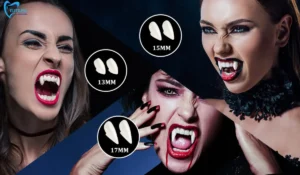
Fake vampire teeth — also called vampire fangs, Halloween fangs, or costume fangs — are the most commonly searched type. They are removable prosthetic caps worn over your own teeth to create a fang appearance for costumes, cosplay, theatre, or Halloween.
Types of Fake Vampire Fangs
| Type | How It Fits | Reusable? | Best For |
| Thermoplastic moldable | Heat beads, mold to your canines | Yes — dozens of uses | Best fit; realistic look |
| Dental adhesive cap | Adhesive paste to tooth | Limited (1–3 uses) | Quick, one-night use |
| Clip-on fangs | Clip to natural teeth | Yes | Budget option; less realistic |
| Full-set fake teeth | Covers multiple teeth | Varies | Dramatic costume effect |
| Professional FX fangs | Custom dental-grade composite | Yes — long-term | Theatre, film, extended wear |
How Fake Vampire Teeth Stay On
Most consumer-grade fake vampire teeth use one of two systems. Thermoplastic beads are heated in warm water until soft, then pressed into the fang cap and molded against your canine tooth. Once cooled, the cap locks to your tooth’s shape and can be repeatedly reseated. Dental adhesive paste creates a temporary bond between the cap and tooth surface — effective for a night but not durable for extended wear.
Professional theatrical fangs use dental-grade materials and are made by a fang artisan or cosmetic dentist to exactly fit your teeth. These are significantly more realistic and comfortable than retail options.
Are Fake Vampire Teeth Safe?
Thermoplastic fangs and professionally made fangs are safe for most people when used as directed. Dental adhesive products should be non-toxic and specifically marketed for oral use. Avoid any product not intended for mouth contact, and do not sleep in fake fangs — this risks choking and pressure damage to your natural teeth.
| ✅ | Safety rule: Only use fangs labeled as safe for oral use. Thermoplastic molding beads should be food-grade. If any fang causes pain, jaw pressure, or difficulty breathing, remove it immediately. |
3. Real Vampire Teeth: Natural Causes of Elongated Canines
Some people are born with — or develop — naturally pronounced canine teeth that genuinely resemble vampire fangs. This is a real dental phenomenon, not a myth. When people ask ‘are vampire teeth real?’ the answer is yes: real vampire-like canines occur naturally and for several documented reasons.
- Genetics: The most common cause. If your parents had prominent canines, you likely will too. Tooth shape and size are primarily inherited traits. Some ethnic backgrounds show higher prevalence of naturally pointed canines.
- Delayed or impacted eruption: When adult canines do not erupt normally, they can emerge in unusual positions — higher on the gumline, more pointed forward, or at angles that make them appear fang-like. This is called an ectopic canine.
- Crowding: If there is not enough space in the dental arch, canines may erupt higher (closer to the gumline) and more prominent than normal, creating a classic vampire teeth appearance.
- Gum recession: When gums recede — exposing more of the tooth root — any canine looks longer. Existing canines can develop a more dramatic appearance purely from gum changes.
- Macrodontia: A rare condition where teeth grow larger than normal. Enlarged canines naturally appear more prominent and fang-like.
From a dental health perspective, naturally prominent canines are usually harmless. However, very elongated canines can sometimes interfere with bite, cause uneven wear on opposing teeth, or contribute to orthodontic crowding — all of which are worth discussing with a dentist.
4. Permanent Vampire Teeth: Cosmetic Dental Options
A growing number of people want vampire teeth permanently — not just for Halloween but as part of their aesthetic identity. Cosmetic dentistry offers several approaches, ranging from reversible to permanent. This is legitimate dental treatment, but it is elective cosmetic work and carries real considerations.
Option 1: Dental Bonding (Most Popular, Reversible)
Dental bonding uses tooth-colored composite resin applied directly to the canine tooth to extend and sharpen it into a fang shape. It requires no drilling of the natural tooth in most cases, is completed in one appointment, costs $150–$400 per tooth, and lasts 3–7 years before needing renewal. It is the most conservative and most commonly chosen approach for vampire teeth.
Option 2: Porcelain Veneers
Dental veneers are thin porcelain shells permanently bonded to the front surface of teeth. Veneers can be shaped to create elongated, pointed vampire canines with a very natural, high-quality appearance. They require minor enamel removal (usually irreversible), cost $1,000–$2,500 per tooth, and last 10–20 years. Veneers are preferred when aesthetics are the top priority and the patient wants a long-lasting result.
Option 3: Natural Tooth Reshaping (Irreversible)
A dentist can file and contour your existing canines to create a sharper, more pointed fang appearance. This requires no added material and is relatively inexpensive. However, it is completely permanent — enamel cannot be restored. This approach reduces the tooth and should be considered very carefully before proceeding.
Option 4: Crowns
Dental crowns cap the entire tooth and can be shaped as fangs. They are typically reserved for situations where the canine already has structural issues requiring a crown. Using crowns purely for cosmetic fang purposes is generally not recommended because it requires significant removal of healthy tooth structure.
| Method | Reversible? | Approx Cost | Durability | Invasiveness |
| Dental bonding | Yes | $150–$400/tooth | 3–7 years | Minimal |
| Porcelain veneers | No (enamel prep) | $1,000–$2,500/tooth | 10–20 years | Low–Moderate |
| Tooth reshaping | No | $75–$300/tooth | Permanent | Low |
| Crowns | No | $800–$2,000/tooth | 10–15+ years | High |
| ⚠️ | Important: Any permanent dental modification — reshaping, bonding, veneers, or crowns — should only be performed by a licensed, qualified cosmetic dentist. Unlicensed ‘fang smithing’ or DIY modifications using non-dental materials risk permanent enamel damage, gum disease, and infection. Always consult a licensed dentist first. |
5. How to Fix or Remove Natural Vampire Teeth
People who have naturally prominent canines and want to reduce them also have options. This is sometimes called vampire teeth correction or canine contouring. A cosmetic dentist can gently reduce the length and sharp point of elongated canines using a process called enameloplasty — removing a very small amount of enamel to reshape the tooth. This is quick, painless, and requires no anesthesia in most cases. For more significant alignment issues, orthodontic treatment (braces or clear aligners) repositions the tooth itself rather than altering its shape.
If crowding is causing the vampire tooth appearance, orthodontics is typically the recommended first step — correcting the position before any cosmetic reshaping is considered.
6. Frequently Asked Questions: Vampire Teeth
Q: What are vampire teeth called in dentistry?
A: In dental terminology, vampire-like teeth are simply elongated or prominent maxillary canines (upper canines). There is no official dental diagnosis called ‘vampire teeth.’ When canines are unusually high in the gum line due to crowding or eruption issues, they may be called ectopic canines. The cosmetic appearance of fang-like teeth is referred to informally as a ‘vampire smile.’
Q: Can you get permanent vampire teeth?
A: Yes. Dental bonding is the most popular method — composite resin extends the canine into a fang shape, is reversible, and costs $150–$400 per tooth. Porcelain veneers offer a longer-lasting, high-quality permanent option at $1,000–$2,500 per tooth. Any permanent modification must be done by a licensed cosmetic dentist.
Q: Are vampire teeth attractive or unattractive?
A: This is entirely subjective and culturally variable. In Japan, the ‘yaeba’ look (prominent upper canines creating a crowded, fang-like smile) has been considered an attractive feature for decades. In Western pop culture, a vampire smile is associated with mystery and edge. Many people find prominent canines distinctive and appealing; others prefer a more uniform smile. There is no objective answer — it is a matter of personal and cultural preference.
Q: How do fake vampire teeth stay on?
A: Consumer vampire fangs use either thermoplastic molding beads (heated, softened, then molded to your canine for a custom fit) or dental adhesive paste. Thermoplastic molding gives a more secure, reusable fit. Dental adhesive is simpler but less durable. Professional theatrical fangs are made from dental-grade composites and fitted by a professional.
Q: Are fake vampire teeth safe?
A: Retail thermoplastic and dental adhesive fangs are safe when used as directed with food-safe, oral-safe materials. Do not sleep in them, do not use non-dental adhesives, and do not wear them if they cause jaw pain or pressure on natural teeth. Children under 12 should only use them with adult supervision.
Q: How much do vampire teeth cost?
A: Fake costume fangs range from $3 for basic clip-ons to $30–$80 for quality moldable fangs to $100–$300 for professional theatrical sets. Permanent dental bonding costs $150–$400 per tooth. Porcelain veneers for a fang look cost $1,000–$2,500 per tooth. Orthodontic correction of ectopic canines (real vampire teeth from crowding) costs $3,000–$6,000 for a full treatment course.
Q: Can a dentist give you real vampire teeth?
A: Yes — a licensed cosmetic dentist can extend your canines to a fang shape using bonding (reversible, conservative) or veneers (more permanent, higher quality). Some cosmetic dentists specialize in this type of work. Avoid any provider who is not a licensed dentist — unlicensed modification of teeth carries serious health risks.
Q: What causes natural vampire teeth?
A: The most common cause is genetics — you inherit prominent canine shape from your parents. Other causes include ectopic canine eruption (the canine emerges in an unusual position due to crowding), delayed eruption, gum recession making the tooth appear longer, and the rare condition macrodontia (abnormally large teeth). Most naturally prominent canines are harmless.
Summary: Everything You Need to Know About Vampire Teeth
Vampire teeth means something different depending on what you are looking for. If you want fangs for Halloween or cosplay, thermoplastic moldable fangs give the best fit and reusability for the price. If you have naturally pointed canines and love the look, embrace them — a vampire smile is genuinely distinctive and, by many standards, appealing. If you want to reduce prominent canines, enameloplasty or orthodontics are your options. And if you want permanent fang modifications, dental bonding is the safest, most reversible starting point — always with a licensed cosmetic dentist.
The key principle across all categories: whether you are buying fake fangs or booking a cosmetic dental consultation, quality and safety matter. Use oral-safe materials for costume teeth. Use a licensed dentist for anything permanent. And know that whatever your reasons for wanting vampire teeth — costume, aesthetic, identity — you are far from alone.
Editorial Note
This article is educational and informational. It does not constitute dental or medical advice. Cost figures are US estimates as of early 2026 and vary by provider and location. Consult a licensed dentist for personal dental guidance.
Medically reviewed by:
Dr. Aziz Liaquat, DDS
Doctor of Dental Surgery
New York University College of Dentistry