
You have probably heard “see your dentist every six months” your entire life. But when you actually try to figure out where that number comes from, the answer gets complicated. It was not based on a clinical study. It came from a 1950s toothpaste advertisement. And it has been repeated so many times that most people now treat it as a medical fact.
The real answer is more nuanced, and understanding it will save you money, prevent unnecessary procedures, and help you build a dental care routine that is actually based on your individual risk level rather than a marketing slogan from seventy years ago.
This guide covers exactly how often you should get a dental checkup and cleaning based on your health profile, what happens during each type of visit, and what the consequences are of going less frequently than you should.
The Honest Answer to How Often You Need a Dental Checkup
The standard recommendation from the American Dental Association is that most adults should have a dental checkup and professional cleaning at least once a year, and twice a year for those with moderate to high risk factors. The six-month rule is not wrong for many people. But it is also not a universal requirement, and it is not based on precise science.
What dental researchers have found is that the right frequency depends almost entirely on your personal oral health status. A 25-year-old with no cavities, healthy gums, no history of gum disease, good daily hygiene habits, and no systemic conditions that affect oral health can likely see a dentist once a year and maintain excellent oral health. A 45-year-old with a history of gum disease, diabetes, dry mouth from medication, or a tendency toward tartar buildup may genuinely need to come in three or four times a year to stay ahead of problems.
The key insight is this: a routine dental checkup is not just about cleaning your teeth. It is a screening appointment. Your dentist is looking for early signs of decay, gum disease, oral cancer, bite problems, and structural issues that you cannot see or feel at home. The frequency of that screening should match your risk level, not a default schedule.
Low Risk vs High Risk: Which Schedule Applies to You
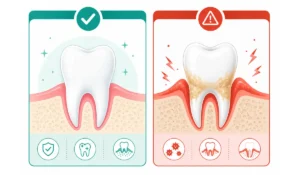
You Are Likely Low Risk If:
You have had no cavities in the past three years, your gums do not bleed when you brush or floss, you brush twice daily and floss daily, you do not smoke, and you have no systemic health conditions like diabetes or autoimmune disorders that affect your gums. If this describes you, once-a-year professional cleanings with a checkup every 12 to 18 months is a clinically reasonable schedule.
You Are Likely High Risk If:
You have a history of gum disease or have been told you have gingivitis. You smoke or use tobacco in any form. You have diabetes, heart disease, or an autoimmune condition. You take medications that cause dry mouth. You tend to build up tartar quickly between visits. You have had multiple cavities or fillings in the past. You are pregnant. If any of these apply, twice-a-year visits are a minimum, and your dentist may recommend three or four visits per year depending on the severity of your risk factors.
Children Need a Different Schedule
Children should see a dentist starting from the time their first tooth appears, or by their first birthday at the latest. After that, every six months is generally appropriate for children because their teeth are still developing, their cavity risk tends to be higher, and early orthodontic issues are far easier to manage when caught young. A pediatric dentist can also apply fluoride treatments and sealants that dramatically reduce cavity risk during the years when it matters most.
What Actually Happens at a Dental Checkup and Cleaning
Many people avoid dental appointments partly because they are not sure what will happen. Here is a clear breakdown of what a complete checkup and cleaning visit includes.
The Examination
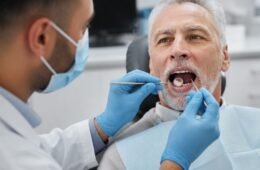
Your dentist performs a visual inspection of every tooth, your gums, your tongue, the roof of your mouth, the inside of your cheeks, and your throat. They are looking for cavities, signs of gum disease, oral cancer indicators, cracked teeth, and bite misalignment. X-rays are typically taken once a year to check for problems between teeth and below the gum line that are not visible during a visual exam.
The Cleaning
Professional cleaning, also called scaling and polishing, removes tartar deposits that brushing and flossing cannot reach. Tartar is hardened plaque that has been sitting on teeth long enough to mineralize. Once it forms, no amount of brushing removes it. Only a dental instrument can. Tartar buildup, when left on teeth, is the primary cause of gum disease because the bacteria living in it irritate and inflame the gum tissue over time.
A professional teeth scaling appointment also includes polishing, which removes surface stains and leaves teeth smoother and harder for new plaque to stick to. For patients who want to understand exactly what scaling involves and what to expect before their first cleaning appointment, the team at Dr. Saad Dentistry explains the teeth scaling procedure in practical detail that helps patients know what to expect before they sit in the chair.
The Conversation
A good checkup ends with a conversation, not just a bill. Your dentist or hygienist should review your brushing and flossing technique, flag any areas of concern, discuss any changes in your health or medications since the last visit, and tell you clearly what they found and what, if anything, needs to be addressed. If you leave a checkup without understanding your oral health status, ask more questions before you go.
What Happens When You Skip Your Dental Checkups

The consequences of skipping dental visits are not immediate, which is exactly why people keep skipping. The damage accumulates over months and years, and by the time you feel it, the easy window has closed.
Tartar that is not removed turns into a chronic source of bacterial inflammation along your gum line. That inflammation, if left untreated, causes the gum tissue to pull away from the tooth, creating pockets where more bacteria accumulate and the infection deepens. This is periodontal disease, and it is irreversible in its advanced stages. The bone that holds your teeth in place begins to recede. Teeth loosen. This process is entirely preventable with regular professional cleanings.
Cavities that are not caught early grow. A cavity detected at a checkup when it is small requires a simple filling that takes 20 minutes and costs a fraction of what comes next. Left for 12 to 18 months, that same cavity reaches the pulp of the tooth and requires a root canal. Left further, it requires extraction. The cost multiplies at each stage, and the discomfort multiplies with it.
Oral cancer, caught in its earliest stage, has a survival rate above 80 percent. Caught late, that number drops dramatically. Every dental checkup includes an oral cancer screening. The exam takes less than two minutes. Missing that exam for several years means missing the best opportunity to catch something early.
How to Find the Right Dental Checkup Schedule for You
The right starting point is a conversation with your dentist at your next visit. Ask them directly: given my current oral health status and history, how often should I be coming in? A good dentist will give you a specific answer based on what they actually see, not a default number. If they say “every six months” without any reasoning attached to your specific situation, ask why.
If you do not have a current dentist or have been avoiding one for a while, the first visit after a gap is usually the most useful. A complete exam will establish a baseline for your oral health, identify anything that has developed during the time you were away, and give you a clear, personalized schedule going forward.
For families who want a single resource that covers everything from basic preventive checkups to more complex restorative work, Dr. Saad Dentistry in Karachi provides a full-service dental care approach with postgraduate-trained specialists who can assess individual risk factors and recommend a checkup frequency that actually fits the patient.

The Bottom Line on Dental Checkup Frequency
Once a year is a reasonable floor for most healthy adults. Twice a year is appropriate for anyone with elevated risk factors. Children should follow a twice-yearly schedule starting from their first tooth. The six-month rule is not wrong, but it is not sacred either. What matters is matching your checkup frequency to your actual risk level, which only a dentist who knows your history can determine accurately.
The biggest mistake people make is treating the absence of pain as a sign that nothing is wrong. Most dental problems, including gum disease, early cavities, and even oral cancer, cause no noticeable symptoms in their early stages. By the time you feel something, the problem is usually no longer a small one.
A routine dental checkup is one of the lowest-cost, highest-impact things you can do for your long-term health. It takes an hour. It prevents problems that take months and thousands of dollars to fix. The only question worth asking is not whether you should go, but how soon you can get on the schedule.
Author Bio : Dr Saad Dentistry is a health and wellness writer covering dental care, preventive health, and patient education. He focuses on breaking down clinical information into clear, practical guidance for everyday readers.