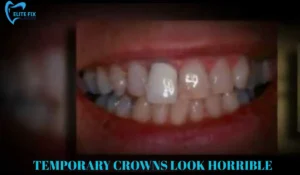
Why They Look Bad, What They Should Look Like, Problems to Watch For & When the Permanent Crown Will Look Better
You just left the dentist’s office with a temporary crown and when you looked in the mirror, your reaction was probably some variation of: this looks horrible. The color is off. It looks bulky, dull, or completely different from your other teeth. Naturally, your next thought is: if the temporary crown looks this bad, is the permanent one going to look the same?
Here is the honest answer you need right now: no. A bad-looking temporary crown does not predict a bad permanent crown. The two are completely different products made from completely different materials by completely different processes. This guide explains exactly why temporary crowns look bad, what a normal temporary crown should look like versus a genuinely problematic one, every symptom and problem worth understanding, and what the permanent crown will actually be like.
| 📌 | Bottom line upfront: Temporary crowns are designed to protect your tooth for 2–3 weeks — not to look beautiful. They are made chairside in 5–10 minutes from acrylic or plastic. Ugly is expected. Your permanent crown is custom-fabricated in a dental laboratory from porcelain or zirconia to precisely match your natural teeth. The difference is significant. |
1. Why Do Temporary Crowns Look Horrible? The Real Reasons
Temporary crowns look bad for specific, predictable reasons — none of which indicate anything is going wrong with your treatment. Understanding these reasons transforms a frustrating experience into a sensible one.
Reason 1: Made from the Wrong Material for Aesthetics
Permanent crowns are made from porcelain, zirconia, or ceramic — materials engineered to mimic the natural translucency, color variation, and surface texture of real tooth enamel. They are custom-tinted to match the specific shade of your surrounding teeth. Temporary crowns are made from acrylic, plastic, or composite resin — much cheaper materials chosen for their ease of manipulation and ease of removal. These materials do not replicate enamel translucency. They look flat, opaque, and noticeably artificial compared to natural teeth. This is the primary reason the temporary crown color looks wrong, even when the shade is technically close.
Reason 2: Made in Minutes at Chairside — Not in a Laboratory
The crown appointment itself takes roughly an hour, and most of that time is spent preparing the tooth — grinding it down to the correct shape and taking the impression that the dental laboratory will use to fabricate the permanent crown. Your dentist then has approximately 5 to 10 minutes to make the temporary crown chairside using a block of acrylic that is carved to a rough approximation of your tooth shape. This technique — called the block temp or direct fabrication method — produces a functional placeholder, not a cosmetic restoration. It will not have the refined contours, smooth margins, or precise color match of a lab-fabricated crown. If the temporary crown looks bad, this time constraint is the most honest explanation.
Reason 3: It Is Intentionally Not Perfect
There is actually a clinical reason some dentists intentionally make temporary crowns look slightly imperfect: to remind patients to come back for the permanent one. It sounds strange, but experienced dentists have seen cases where a temporary crown that looks too convincing results in the patient never returning for the final restoration — assuming the temporary is good enough. The temporary crown exists to protect the prepared tooth and maintain spacing. It is a placeholder, not a finished product.
Reason 4: Not Engineered to Match Your Specific Teeth
Temporary crowns are made from prefabricated forms or stock materials that approximate tooth shape but are not derived from a precise mold of your specific tooth. Permanent crowns, by contrast, are built from an exact digital scan or physical impression of your prepared tooth and your surrounding bite. This means the permanent crown will fit differently, feel different, and look different — in all the ways that matter for appearance. The temporary crown bigger than original tooth feeling many patients notice is common, as the acrylic form is carved to approximate shape rather than precisely match it.
2. What Does a Temporary Crown Look Like? Setting Realistic Expectations
When people search for what does a temporary crown look like or what does a temp crown look like, they are usually trying to find out whether their experience is normal. Here is an honest description of what to expect.
A normal temporary crown looks like a tooth-shaped cap in a standard off-white or tooth-colored shade. It will not be a perfect color match to your adjacent teeth. It will have less surface detail and appear more uniform and matte than natural enamel. If it is on a back molar, it may appear slightly blocky or oversized. If it is on a front tooth — and your front teeth temporary crowns look horrible — you will likely be more distressed because front teeth are always visible. This is completely understandable and the discomfort is valid, even if the temporary crown is functioning correctly.
What you should not see: significant gaps between the crown and gum line, obvious misalignment with adjacent teeth causing bite problems, or a crown that is visibly dark, black, or severely discolored. Those findings may indicate a problem worth discussing with your dentist.
| Feature | Temporary Crown (Normal) | Permanent Crown |
| Material | Acrylic, plastic, or composite resin | Porcelain, zirconia, ceramic, or PFM (porcelain-fused-to-metal) |
| Color match | Approximate — standard stock shade, not custom-tinted | Custom-matched to your surrounding teeth using a shade guide |
| Fabrication | Chairside in 5–10 minutes by your dentist | Custom-fabricated over 2–3 weeks in a professional dental laboratory |
| Translucency | Opaque and flat — lacks natural enamel light transmission | Designed to mimic enamel translucency and surface texture |
| Fit precision | Approximate — based on stock forms, not your exact tooth | Exact — built from a precise digital or physical impression |
| Cement type | Temporary adhesive — designed for easy removal | Permanent cement — bonded for long-term retention |
| Durability | 2–3 weeks; avoid hard, sticky foods | 10–15+ years with proper care |
| Purpose | Protect prepared tooth and maintain spacing during lab fabrication | Full restoration — aesthetic, functional, long-term |
3. Temporary vs. Permanent Crown: Will the Permanent One Look Better?
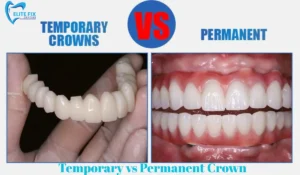
Temporary vs Permanent Crown
The most important question anyone in this situation is really asking is: will my permanent crown look as bad as this temporary one? The answer is almost always no — and for concrete reasons, not just reassurance.
When comparing temporary vs. permanent crown appearance, the distinction comes down to the entire fabrication process. Your permanent crown begins with a precise impression or digital scan of your prepared tooth. A dental laboratory technician — a skilled professional whose entire career is dedicated to creating realistic-looking dental restorations — crafts the crown from porcelain or zirconia over several working days. The shade is matched using a shade guide at your appointment to correspond to the exact color of your neighboring teeth. The surface texture, contours, and margins are refined to blend seamlessly with your smile.
The only situation where a permanent crown might still disappoint cosmetically is when the patient and dentist have not clearly communicated expectations about shade, shape, or size — particularly for very visible front teeth. This is why some dentists offer a diagnostic wax-up before crown preparation: a preview of the proposed restoration’s appearance in wax form, giving you the chance to request adjustments before anything is permanently cemented. If cosmetics matter significantly to you — especially for front teeth — ask your dentist about this option before the preparation appointment.
| 💡 | Smart patient tip: Before your permanent crown is cemented in place, ask your dentist to place it on your tooth without cement first and hand you a mirror. Take your time looking from multiple angles. If you have concerns about color or shape, raise them then. Once bonded with permanent cement, adjustments become very limited. This is your best window to speak up. |
4. Temporary Crown Looks Bad vs. Genuinely Problem Signs
There is an important distinction between a temporary crown that looks bad for normal aesthetic reasons — acceptable and expected — and a temporary crown that has a genuine clinical problem. Knowing the difference helps you decide what needs a call to your dentist versus what you simply need to wait through.
Normal Aesthetic Issues (Expected — No Concern)
- Color mismatch: The temporary crown looks whiter, darker, or more yellow than your natural teeth. This is expected given the stock material used.
- Slightly bulky shape: The temporary crown bigger than original tooth feeling is common. Acrylic forms are approximate, not precise.
- Matte or flat appearance: Lacks the subtle translucency of natural enamel. Completely normal for acrylic.
- Crown feels weird at first: The dental crown feels weird sensation in the first few days is extremely common as your tongue and bite adapt to the new shape. The brain initially registers unfamiliar objects as foreign.
- Crown feels rough: Slight roughness on acrylic surfaces is expected. The permanent crown will have a highly polished, smooth surface.
Problems That Warrant a Call to Your Dentist
- Bad temporary crown fit — gaps at the gumline: Visible gaps between the crown and the gum allow bacteria to enter the prepared tooth area, risking decay under the crown or infection. A crown not sealed properly should be evaluated promptly.
- Temporary crown feels too high — bite issues: If the crown is too high symptoms include immediate pain when biting down, soreness after eating, and jaw discomfort. A crown too high symptoms that persist beyond a day or two need adjustment. A high crown left uncorrected causes uneven force distribution and can progress to jaw strain, TMJ discomfort, and headaches. This is a quick, painless adjustment your dentist can make in minutes.
- Crown feels loose or moves: The temporary crown is cemented with temporary adhesive by design, but it should not visibly shift or feel wobbly. A loose temporary crown that moves can expose the prepared tooth and allow bacteria to enter. If the crown loose and hurts or you can feel it move with your tongue, call your dentist.
- Crown smells bad or crown stinks: A bad smell from crown or temporary crown stinks situation can indicate bacterial activity beneath the margin or leakage of cement. The crown smells bad or crown smell so bad problem may be accompanied by a bad taste coming from crown or bad taste in mouth after crown. These signs together suggest the seal has been compromised.
- Crown leaking taste: A crown leaking sensation — particularly metallic or unpleasant taste — indicates the temporary cement is not fully sealing the margin. Crown leaking should be reported to your dentist, especially if it persists beyond a few days.
- Severe or worsening pain: Some dental crown pain and temporary crown discomfort in the first 48–72 hours is normal as the tooth adjusts. Crown pain that worsens after a week, crown pain that comes and goes persistently, or tooth pain under crown that is severe suggests the underlying tooth may be inflamed or infected.
| Symptom / Sign | What It Indicates | Urgency | Action |
| Color mismatch | Normal — stock acrylic material | None | Wait for permanent crown |
| Crown feels weird at first | Normal brain adaptation to new shape | None | Resolves in days |
| Crown feels too high | Bite misalignment — crown too tall | Moderate | Call dentist for adjustment |
| Crown feels rough or gritty | Surface texture of acrylic material | None | Normal — permanent crown is smooth |
| Bad taste from crown | Leakage at margin or bacterial activity | Moderate | Call dentist within a few days |
| Crown smells bad | Bacteria beneath crown or seal failure | Moderate–High | Call dentist |
| Crown feels loose | Temporary cement weakening or crown displaced | High | Call dentist promptly |
| Tooth pain under crown | Pulp inflammation, infection, or bite issue | High | Call dentist; may need evaluation |
| Crown broke off with tooth | Structural failure of temporary | High | Call dentist immediately |
| Swelling, fever, severe pain | Possible abscess or serious infection | Emergency | Seek care immediately |
5. Temporary Crown Pain, Sensitivity & Discomfort: What Is Normal?
Dental crown pain after placement is one of the most common patient concerns — and understanding what is normal versus what needs attention makes a significant difference in managing the experience.
Normal in the First 48–72 Hours
Mild tooth crown pain in the first two to three days after placement is expected. The prepared tooth and surrounding gum tissue have experienced significant manipulation during the appointment, and mild inflammation, pressure sensitivity, and temperature sensitivity are all normal healing responses. Crown sore when chewing is common in this window, particularly on harder foods. Crown discomfort during this period typically responds well to over-the-counter ibuprofen and salt water rinses.
Dental Crown Bite Adjustment Symptoms
If the crown hurts when you put pressure on it specifically when biting, and this persists beyond a few days, the crown may be sitting too high — what dentists call a ‘high bite.’ The crown feels too high when biting down, you feel the crowned tooth hitting first before your other teeth meet, or you feel jaw soreness after meals. Crown feels weird when biting down or crown doesn’t feel right sensations that localize to this pressure-specific pattern usually resolve immediately after a simple bite adjustment appointment. This adjustment takes minutes, requires no anesthesia, and is covered as part of your crown treatment. Do not wait weeks hoping it resolves — contact your dentist for adjustment.
Tooth Pain Under Crown: When to Be Concerned
Tooth pain under crown that appears several days after placement and persists or worsens is different from normal post-procedure sensitivity. Tooth hurting under crown symptoms that are throbbing, spontaneous (not triggered only by eating), or wake you at night suggest the nerve inside the tooth is inflamed or infected — a condition called pulpitis. In some cases this develops because the tooth had existing nerve damage that the crown preparation process aggravated. Crown tooth pain after years or tooth crown pain after years is a separate situation — a crown that was fine for a long time developing pain usually indicates decay under the crown, a cracked tooth, or a failing seal. A bad fitting crown symptoms pattern that develops over time warrants professional evaluation.
Crown Pain Comes and Goes
Tooth pain under crown comes and goes is a pattern worth reporting to your dentist. Intermittent crown pain suggests a bite issue (pain with specific foods or jaw positions), early pulp inflammation responding to temperature changes, or partial loosening allowing micromovement. Tooth pain on crown that comes and goes rather than being constant is generally a better prognostic sign than continuous severe pain, but it should not be ignored or waited out indefinitely.
6. Bad Crown Symptoms: How to Recognize a Poorly Fitted or Failing Crown
Bad dental crown symptoms apply to both temporary and permanent crowns. Understanding what a bad crown feels like helps patients identify problems before they escalate into more serious dental complications.
Bad Fitting Crown Symptoms
A crown not seated properly produces a distinctive set of sensations. Crown doesn’t feel right in a general way that you cannot ignore — unlike the expected early adjustment — is the first signal. Specific bad crown symptoms from poor fit include: bite that feels persistently off even after adjustment, visible gaps at the margin between crown and gum, crown sore when chewing on one specific side, and gum tissue that stays irritated or swollen around the crown margin rather than settling down after the first week.
Dental crown not seated properly can be confirmed by your dentist with clinical examination and X-ray, which shows whether the crown margins are fully seated against the tooth structure or if there are open spaces. Crown placement errors are not always apparent clinically without radiographic confirmation.
Bad Crown on Front Teeth
Bad crowns on front teeth are particularly distressing because front teeth are always visible in conversation, in photographs, and when smiling. Signs of a genuinely problematic front crown include significant color discrepancy that draws immediate notice, obvious size difference from adjacent teeth, an unnatural appearance that does not improve after the first few weeks of adjustment, or gum tissue that is chronically red or irritated around the crown margin suggesting poor fit.
Crown Smells Bad — Bad Smell from Crown
Crown smells bad is one of the most alarming symptoms patients report — and it is clinically significant. Crowns smell bad when bacteria have established colonies beneath the crown margin, either because the crown is not sealed properly, the cement has washed out, or there is decay under the crown. A crown leaking taste of metallic or decay, combined with crown smell bad symptoms, indicates the protective seal has been compromised. If your tooth crown smells like poop or the smell coming from the crown is distinctly putrid, the degree of bacterial activity is likely significant. This combination of bad taste coming from crown and odor warrants prompt dental evaluation rather than a wait-and-see approach.
Crown Is Loose and Hurts
Crown is loose and hurts or crown loose is a situation requiring prompt attention, not at-home management. A crown that moves allows bacteria direct access to the prepared tooth underneath, accelerating decay under crown development. Tooth decay under crown symptoms include sensitivity that develops or worsens over time and a crown that gradually loosens further. Once decay progresses beneath a crown, the treatment becomes significantly more complex — potentially requiring root canal therapy or loss of the tooth if bone becomes involved.
7. Crown Infection: Signs, Symptoms & When to Seek Immediate Care
Dental crown infection and tooth infection under crown are serious situations that require professional care — not home management. Understanding the signs prevents a treatable infection from becoming an emergency.
Signs of Infection Under a Crown
- Swelling: Visible swelling of the gum around the crown, or facial swelling spreading beyond the tooth area.
- Persistent throbbing pain: A tooth abscess under crown typically produces constant, worsening pain rather than the intermittent sensitivity of normal adjustment.
- Crown abscess: A bump or pimple on the gum near the crowned tooth that may release pus. This is called a dental fistula or gum boil and indicates active infection draining from around the root.
- Bad taste: Persistent bad taste that accompanies swelling or pain suggests an abscess is discharging into the mouth.
- Fever: Any dental pain accompanied by a fever is an emergency. Dental infection that spreads beyond the tooth into surrounding bone or soft tissue is a medical emergency requiring immediate care, not a phone call scheduled for next week.
- Crown and gum pain together: Crown and gum pain combined with visible swelling and pus is an abscess until proven otherwise. Seek same-day care.
| 🚨 | Emergency: if you experience significant facial swelling, difficulty swallowing or breathing, a high fever with dental pain, or pus from the gum around your crown — seek emergency dental or medical care immediately. A spreading dental infection is a medical emergency. Do not wait for a routine appointment. |
8. How to Care for a Temporary Crown: Protecting It Until Your Permanent Crown Arrives
Proper care of a temporary crown significantly reduces the risk of problems during the 2–3 week waiting period between tooth preparation and permanent crown placement.
- Avoid hard and sticky foods: Caramel, hard candy, nuts, crusty bread, and chewing ice are the primary causes of temporary crowns dislodging or fracturing. The acrylic is not designed for these stresses.
- Chew on the opposite side: Direct biting pressure on a temporary crown — especially from hard or chewy foods — can dislodge it. Shifting chewing to the other side of your mouth reduces this risk significantly.
- Floss carefully: Rather than pulling floss upward through the contact between the temporary crown and adjacent teeth — which can pull the crown off — slide the floss out sideways from the contact point. Some dentists suggest skipping floss on the temporary crown tooth and using a water flosser or saltwater rinse instead.
- Use a soft toothbrush and gentle brushing: Brush gently around the crown margin. The temporary cement is not as robust as permanent bonding; aggressive brushing around the margin can disturb the seal over time.
- Saltwater rinses: If your gums around the crown are tender or slightly inflamed, warm saltwater rinses two to three times a day help reduce inflammation and keep the area clean without disturbing the crown margin.
- Report anything that concerns you: If the crown comes off, hurts significantly, tastes bad, smells, or feels seriously wrong — call your dentist. Temporary crown problems are easier to fix early. Do not wait until your permanent crown appointment.
9. Frequently Asked Questions About Temporary Crowns
Q: Why does my temporary crown look so horrible?
A: Temporary crowns look bad for three main reasons: they are made from acrylic or plastic rather than the porcelain or zirconia used for permanent crowns; they are fabricated chairside in 5–10 minutes without the time for precise color-matching or contouring; and they are designed as functional placeholders, not aesthetic restorations. Your permanent crown will be custom-fabricated over 2–3 weeks in a dental laboratory using materials specifically engineered to look like natural teeth.
Q: Is it normal for a temporary crown to look bad?
A: Yes — completely normal. A temporary crown that looks noticeably different from your natural teeth, appears flat or opaque, or sits slightly larger than your original tooth is performing exactly as intended. The only things that are not normal are: significant pain when biting, a crown that moves or is clearly loose, a bad taste or smell coming from the crown, gum swelling, or fever. Those symptoms warrant a call to your dentist.
Q: What does a temporary crown look like?
A: A temporary crown looks like a tooth-shaped cap in an off-white or stock tooth color that approximates but does not precisely match your natural teeth. It has a flat, slightly opaque appearance compared to real enamel. It may appear slightly larger or differently contoured than your original tooth. For front teeth, the mismatch is more noticeable because front teeth are visible and have more complex shapes than molars.
Q: Will the permanent crown look better than the temporary one?
A: In almost every case, yes. The permanent crown is custom-fabricated from a precise impression of your tooth, shade-matched to your adjacent teeth using a professional guide, and crafted from porcelain or zirconia that mimics the translucency and texture of natural enamel. The difference in appearance between a temporary and permanent crown is significant. If you have genuine concerns about the permanent crown’s expected appearance — particularly for front teeth — discuss them with your dentist before the preparation appointment, not after.
Q: My temporary crown feels weird — is this normal?
A: Yes. Crown feels weird sensations in the first few days after placement are expected. Your tongue and bite are adapting to a new shape in a familiar space. Crown feels weird when chewing, crown feels gritty, or crown doesn’t feel right are all commonly reported in the first week and typically resolve as adaptation occurs. If the crown feels too high when biting — meaning your crowned tooth hits before the rest of your teeth meet — contact your dentist for a quick bite adjustment.
Q: Why does my temporary crown smell bad?
A: A temporary crown smells bad or crown stinks when bacteria have gotten beneath the crown margin. This can happen if the temporary cement has partially washed out or if the seal was not complete. Bad smell from crown combined with a bad taste coming from crown or crown leaking taste indicates the protective seal has been compromised. Contact your dentist to have the crown re-examined and potentially re-cemented or adjusted.
Q: My temporary crown is loose — what should I do?
A: Do not ignore a loose crown. The crown is loose and hurts or the crown moves when you touch it with your tongue because temporary cement has weakened, worn, or been disturbed. A loose temporary crown exposes the prepared tooth underneath to bacteria, which can cause rapid decay under the crown. Call your dentist promptly — re-cementing a temporary crown is a quick, usually painless procedure. Do not try to re-cement it yourself with over-the-counter adhesives, as these can interfere with the final crown fitting.
Q: How long do temporary crowns last?
A: Temporary crowns are designed to last 2–3 weeks — the time required for the permanent crown to be fabricated in the dental laboratory. With proper care (avoiding hard and sticky foods, gentle flossing technique, avoiding chewing on that side), most temporary crowns last comfortably through this period. In some situations — complex treatment planning, patient scheduling — a temporary crown may need to last 4–6 weeks. If yours needs to last longer than a few weeks, discuss reinforcement options with your dentist.
Q: Can I improve how my temporary crown looks?
A: There are limited options. Your dentist can smooth rough edges or improve surface polish with a simple chairside adjustment at no additional cost — ask for this if the surface roughness is bothering you. For front teeth where appearance is critical, some dentists offer lab-fabricated temporary crowns (PMMA or similar) that are made by the dental laboratory using better materials and more precise contouring — these look significantly better but require additional time and cost. A diagnostic wax-up before the crown preparation appointment can also preview the final appearance and help prevent aesthetic disappointment with the permanent crown.
Q: What are signs of a bad crown I should watch for?
A: Bad crown symptoms include: a crown that feels persistently too high even after supposed adjustment; visible gaps at the gum margin; a crown that feels loose or moves; persistent or worsening pain when biting; a bad taste or smell from the crown area; gum swelling or inflammation that does not resolve after the first week; and in the case of a permanent crown, significant color mismatch that was not present at initial placement. These signs warrant professional evaluation rather than watchful waiting.
Q: Can a temporary crown get infected?
A: Yes. While infection of the temporary crown itself is not typical, the tooth underneath can develop or reveal an infection during the temporary crown period. Signs include throbbing pain, a bump or pimple on the gum near the crown (dental abscess or fistula), bad taste, swelling, and fever. A tooth infection after crown or dental crown infection presenting with these symptoms needs prompt professional attention. Fever combined with dental pain and swelling is a dental emergency.
What to Remember About Temporary Crowns
Temporary crowns look horrible to most patients — and that is completely expected. They are acrylic placeholders made chairside in minutes, designed to protect your tooth while a professional laboratory fabricates the real restoration. The material, the color match, the contours, and the overall appearance of a temporary crown cannot and should not be compared to what your permanent crown will look like.
Your permanent crown is a different product entirely: custom-fabricated from porcelain or zirconia, shade-matched to your specific teeth, crafted over several days by a skilled technician, and built from a precise impression of your own tooth. The improvement in appearance is significant and expected.
What you do need to pay attention to during the temporary crown period: a crown that fits too high and causes pain when biting, a loose crown, any bad taste or smell coming from the crown, signs of infection such as swelling or fever, and pain that worsens rather than gradually improves after the first week. These are signals to call your dentist — not tomorrow, and not next week.
Everything else — the color, the shape, the way it feels different, the surface texture — is temporary in the most literal sense. The 2–3 weeks until your permanent crown is placed is the timeline you are managing. After that, the restoration you have been waiting for will be there.
Editorial Note
This article is educational, patient-centered, and non-promotional. All clinical information is synthesized from published dental sources including Jackson Ave Dental, NewMouth, Rockford Health System, St. George Dental Care, BellevueRX, The Dental Team, Mahogany Dental Wellness, Freitas Dentistry, Alma & Katz DMD, Brooksher Dental, and Dentistry on Wellington. No specific providers are recommended. This article does not constitute dental advice. Consult a licensed dentist for personal guidance.
Medically Reviewed by: Dr. Aziz Liaquat, DDS — Elite Fix Denture Experienced in restorative dentistry and crown procedures, including temporary and permanent crown placement, fit evaluation, and patient care management.