INVISALIGN VS BRACES
Which Is Better for Adults? An Honest, Evidence-Based 2026 Guide to Cost, Comfort, Treatment Time & Results
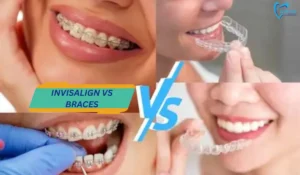
| 😁 INVISALIGN Clear aligners · Removable · Nearly invisible | 🦷 BRACES Fixed brackets + wires · Proven for all cases |
The Short Answer: Invisalign vs Braces for Adults
The honest answer is: neither is universally better. The right choice depends entirely on the complexity of your case, your lifestyle, your budget, and how much discipline you have for wearing removable aligners consistently.
Invisalign is better for adults who want a discreet, low-hassle orthodontic experience for mild to moderate alignment issues. Traditional braces are still the superior choice for complex bite corrections, severe crowding, or rotational tooth movement — and they cost less on average.
This guide covers everything adults need to make an informed decision: the clinical differences, the real cost breakdown, treatment timelines, what each option cannot do, and a situation-by-situation recommendation table so you can see which fits your specific case.
| 📌 | This is an independent, non-promotional comparison. Neither Invisalign nor any orthodontic brand has influenced this content. All cost ranges are based on 2024–2025 US dental fee surveys. Individual quotes from your orthodontist will vary. |
What Is Invisalign? What Are Braces? (Quick Definitions)
Invisalign
Invisalign is a brand of clear aligner orthodontic treatment made by Align Technology. Treatment consists of a series of custom-made, removable clear plastic trays (aligners) worn over the teeth. Each aligner moves teeth a small amount, and you progress through the series every one to two weeks. Invisalign is the market leader in clear aligners but is not the only brand — competitors include ClearCorrect, Spark, and others. For simplicity, ‘Invisalign’ in this article refers to clear aligner treatment broadly.
Traditional Braces
Traditional braces consist of metal or ceramic brackets bonded to each tooth, connected by archwires and small elastic bands. The orthodontist adjusts the wire tension at regular appointments to guide tooth movement. Braces are fixed — they cannot be removed by the patient — and remain in place 24 hours a day for the full treatment duration. Lingual braces are a variation placed behind the teeth (invisible from the front) at significantly higher cost.
Invisalign vs Braces: Full Side-by-Side Comparison
| Category | Invisalign | Traditional Braces |
| Avg. Cost (Adults) | $3,500 – $8,000 | $2,500 – $7,500 |
| Visibility | Nearly invisible | Visible metal or ceramic |
| Removable? | ✅ Yes — must wear 20–22 hrs/day | ❌ No — fixed 24/7 |
| Comfort | Smooth plastic, no wires | Brackets/wires can irritate |
| Eating Restrictions | None (remove to eat) | Many — avoid hard/sticky foods |
| Oral Hygiene | Easy — remove to brush/floss | Harder — special tools needed |
| Suitable for Complex Cases | Moderate — not all cases | ✅ Yes — handles severe cases |
| Treatment Time | 6–18 months (avg adults) | 18–24 months (avg adults) |
| Dental Visits | Every 6–8 weeks | Every 4–6 weeks |
| Compliance Required | High — must wear consistently | Low — fixed, no discipline needed |
| Best For | Mild–moderate crowding, adults | Severe/complex cases, all ages |
Invisalign vs Braces Cost for Adults: What You’ll Actually Pay
Cost is the most-searched factor in the Invisalign vs braces comparison — and the answer is more nuanced than most sources admit. Here is an honest breakdown of US costs in 2026.
| Treatment | Low End | High End | Insurance Coverage |
| Invisalign Full | $3,500 | $8,000 | Partial — varies |
| Invisalign Lite | $2,500 | $4,500 | Partial — varies |
| Metal Braces | $2,500 | $6,000 | Partial — varies |
| Ceramic Braces | $3,500 | $7,500 | Partial — varies |
| Lingual Braces | $5,000 | $13,000 | Rare |
Why costs vary so much: Geographic location, orthodontist experience, case complexity, and whether you need tooth extractions or additional procedures all affect your final price. A simple spacing case in a small city will cost less than a complex bite correction at a specialist practice in a major metro area.
Insurance coverage: Most dental insurance plans that include orthodontic coverage provide a lifetime orthodontic benefit of $1,000 to $3,000 — applied to either Invisalign or braces without distinction. Many orthodontists offer 0% financing plans that spread the remaining cost over 12 to 24 months.
HSA/FSA eligible: Both Invisalign and braces qualify as orthodontic treatment under Health Savings Accounts (HSA) and Flexible Spending Accounts (FSA), making them tax-advantaged purchases. This can effectively reduce your out-of-pocket cost by 20 to 30% depending on your tax bracket.
| ⚠️ | Avoid ‘direct-to-consumer’ mail-order aligner services (Smile Direct Club and similar) for anything beyond very minor cosmetic adjustments. These services provide no clinical oversight of your bite, bone, or root health. The American Association of Orthodontists and the ADA have issued consumer warnings about these products. Multiple class-action lawsuits and bankruptcy proceedings (including Smile Direct Club in 2023) have left patients mid-treatment without recourse. |
Treatment Time: How Long Does Each Take for Adults?
Invisalign for adults: Typically 6 to 18 months for mild to moderate cases. Full Invisalign treatment for complex adult cases can run 18 to 24 months. The average adult Invisalign treatment is approximately 12 months.
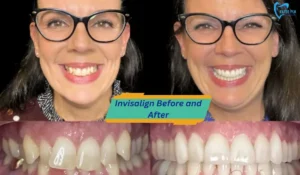
Invisalign Before And After
Braces for adults: Typically 18 to 24 months for most adult cases. Complex cases involving significant bite correction can extend to 36 months. Adults generally take longer than teens because adult bone density is higher, making teeth move more slowly.
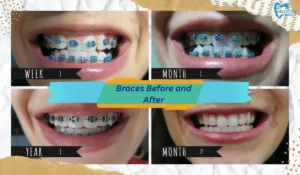
Braces Before And After
What affects treatment time most: Case complexity is the dominant factor. Wearing Invisalign for the required 20 to 22 hours per day is the second biggest factor — every hour of missed wear extends treatment. Missed orthodontic appointments slow both treatments.
| 💡 | Adults consistently take 20–30% longer than teenagers for equivalent orthodontic corrections. This is not a flaw — it reflects the difference in bone remodeling speed between mature and developing jaws. Set realistic expectations before starting treatment and ask your orthodontist for a case-specific timeline, not a generic average. |
Comfort Comparison: Invisalign vs Braces
Invisalign Comfort
Most adults rate Invisalign as more comfortable than braces day-to-day. The smooth plastic aligners produce no sharp edges, no bracket irritation, and no wire poking. The primary discomfort is pressure — a tightness felt for 1 to 2 days after switching to each new aligner as the teeth begin moving. This fades quickly and is generally manageable with over-the-counter pain relievers.
Braces Comfort
Braces cause more ongoing discomfort for most patients. The brackets and wires can scratch and irritate the inner lips and cheeks, especially in the first few weeks. Soreness after adjustment appointments typically lasts 2 to 4 days. Orthodontic wax helps with sharp wire irritation. The discomfort is real but manageable — the vast majority of braces patients complete treatment without serious comfort issues.
Emergency Situations
Broken brackets and poking wires are the most common brace-related emergencies — uncomfortable and requiring an orthodontist visit. Invisalign emergencies are rare: a cracked aligner is the main issue, usually handled by moving to the next tray early or ordering a replacement.
Appearance: Which Is More Discreet?
For adults concerned about appearance — in professional environments, social situations, or on camera — this is often the deciding factor.
- Invisalign aligners are nearly invisible to most people at normal conversational distance. They are the clear winner for adult aesthetics.
- Metal braces are the most visible option. Widely accepted socially, but clearly orthodontic treatment.
- Ceramic (tooth-colored) braces are significantly less visible than metal but not as discreet as clear aligners — and slightly more expensive.
- Lingual braces (placed behind the teeth) are invisible from the front but significantly more expensive ($5,000–$13,000) and can affect speech temporarily.
| 💡 | If aesthetics are your primary concern, Invisalign wins clearly. If your case is complex and requires braces, ceramic braces offer the best visual compromise without the cost premium of lingual braces. |
Oral Hygiene: Important Differences for Adults
Invisalign Oral Hygiene
Invisalign aligners are removed for eating, drinking anything other than water, brushing, and flossing. This means your oral hygiene routine does not change — you brush and floss normally, twice daily, and clean the aligners separately. Adults with existing dental restorations, crowns, or bridges often find this significantly easier. The risk: drinking coffee, tea, or wine while wearing aligners stains the trays and creates a concentrated acid environment against your teeth.
Braces Oral Hygiene
Braces create multiple spaces for food to trap. Proper cleaning requires an interdental brush, a floss threader or Waterpik, and more time per session. Failure to clean thoroughly around brackets causes white spot lesions — permanent enamel demineralization that remains visible after braces are removed. This is the most preventable and most commonly regretted outcome of braces treatment in adults. A Waterpik (water flosser) is strongly recommended for anyone with braces.
| 📌 | Adults are more likely than teens to have the discipline for good oral hygiene with braces — but the structural difficulty is genuinely higher. If you have bridges, implants, or multiple restorations, Invisalign’s removability provides a real clinical advantage for maintaining existing dental work. |
What Invisalign Cannot Do (And What Braces Handle Better)
The marketing around clear aligners sometimes glosses over genuine clinical limitations. Here is what Invisalign handles less effectively than braces:
- Severe rotational corrections: Teeth that need significant rotation (especially premolars and canines) are harder to move predictably with aligners. Attachments (small composite buttons bonded to teeth) help, but braces still outperform aligners for these movements.
- Large vertical movements (intrusion/extrusion): Moving teeth significantly up or down in the arch is more reliably achieved with fixed wires.
- Severe bite corrections: Class II (overbite) and Class III (underbite) corrections involving significant jaw discrepancies are more effectively managed with braces, sometimes in combination with elastics or orthognathic surgery.
- Non-compliant patients: Invisalign completely fails if aligners are not worn 20–22 hours per day. Adults who know they will remove aligners frequently are better served by fixed braces.
- Severely crowded teeth: Cases requiring multiple extractions followed by significant space closure are generally handled more precisely with braces.
| ✅ | Invisalign technology has improved dramatically since its introduction in 1997. The gap between aligners and braces has narrowed significantly. An experienced clear aligner orthodontist can now treat the majority of adult cases successfully — but for the most complex presentations, braces remain the gold standard. |
Which Should YOU Choose? Situation-by-Situation Guide
| Your Situation | Better Choice | Why |
| Mild crowding or spacing | Invisalign | Handles well; nearly invisible |
| Severe bite issues (overbite, underbite) | Braces | More precise force control |
| Self-conscious about appearance | Invisalign | Barely noticeable |
| Low compliance / forgetful | Braces | No wear discipline required |
| Athlete or contact sport player | Invisalign | No sharp brackets, removable |
| Professional adult (business/social life) | Invisalign | Aesthetic advantage |
| Budget is the primary factor | Metal Braces | Lowest cost option |
| Very complex tooth movement needed | Braces | Handles rotation/vertical better |
| Playing wind instrument | Invisalign | Easier adjustment |
| Teen or child | Braces | More proven, more durable |
After Treatment: Retainers Are Non-Negotiable for Both
One of the most important and least-discussed aspects of orthodontic treatment for adults is retention. Teeth have a natural tendency to shift back toward their original position — a process called relapse. This is equally true for both Invisalign and braces patients.
- After Invisalign: You will receive Vivera retainers (clear retainers similar to aligners) or fixed wire retainers bonded behind the front teeth. Most orthodontists recommend wearing removable retainers nightly for life — not just for a year or two.
- After braces: The same — fixed lower retainer bonded behind front teeth is common, plus a removable upper retainer for nightly use indefinitely.
- Adults relapse faster than teens if retainers are not worn — adult teeth have longer histories of their original positions and tend to remember them more aggressively.
| ⚠️ | Skipping retainers after orthodontic treatment is the single most common reason adults need to repeat treatment in their 40s and 50s. The cost of orthodontic relapse far exceeds the minor inconvenience of wearing a retainer nightly. Both Invisalign and braces results are permanent only if you wear retainers as directed. |
Frequently Asked Questions
Q: Is Invisalign as effective as braces for adults?
A: For mild to moderate crowding, spacing, and bite issues, Invisalign achieves results comparable to braces for most adults. For complex cases involving severe rotations, large vertical movements, or significant bite discrepancies, traditional braces remain more effective. The right answer depends on your specific case — your orthodontist’s assessment is the definitive guide.
Q: How much does Invisalign cost compared to braces for adults?
A: Invisalign Full typically costs $3,500 to $8,000; traditional metal braces typically cost $2,500 to $6,000 for adults. The cost difference has narrowed significantly as clear aligner technology has become mainstream. Insurance, HSA/FSA accounts, and orthodontist financing can reduce out-of-pocket costs for either option. Get multiple quotes — prices vary widely by location and provider.
Q: Can adults get Invisalign or is it mainly for teens?
A: Invisalign was originally designed for adults and remains highly popular with the adult demographic. There is no upper age limit for clear aligner or braces treatment in adults. Orthodontic treatment works at any adult age, though treatment times are slightly longer for older adults due to slower bone remodeling.
Q: Does Invisalign hurt more or less than braces?
A: Most adults report Invisalign is more comfortable overall. Aligner pressure discomfort (lasting 1–2 days per new tray) is generally milder than braces adjustment soreness (2–4 days per adjustment). Braces also cause ongoing bracket and wire irritation that aligners do not. However, pain tolerance varies — neither treatment is pain-free.
Q: Can I get Invisalign if I have had braces before?
A: Yes. Many adults who had braces as teens seek Invisalign treatment later in life due to orthodontic relapse from not wearing retainers consistently. This is one of the most common adult clear aligner presentations. Retreatment is generally shorter than original treatment if the relapse is mild to moderate.
Q: What is the difference between Invisalign and braces for severe cases?
A: Severe cases — significant overbite, underbite, crossbite, severe crowding requiring extractions — are generally treated more predictably with braces. Invisalign has improved substantially for complex cases but still has limitations in precise torque control and large vertical tooth movements. If your orthodontist recommends braces for a complex case, this is a clinical judgment worth taking seriously.
Q: Do braces or Invisalign work faster?
A: Invisalign typically achieves faster results for mild to moderate adult cases (6–18 months vs 18–24 months for braces). For complex cases, treatment times are comparable. Invisalign works fastest when aligners are worn consistently for 20–22 hours per day — missing even a few hours daily can add months to treatment.
Q: Will insurance cover Invisalign or braces for adults?
A: Most dental insurance plans with orthodontic benefits cover both Invisalign and braces equally, applying the same lifetime orthodontic maximum (typically $1,000–$3,000) to either treatment. Some older or less comprehensive plans may specify ‘traditional braces only’ — check your policy language before choosing. Both treatments also qualify for HSA and FSA spending.
Final Verdict: Invisalign vs Braces for Adults
The question ‘is Invisalign better than braces for adults?’ does not have a universal answer — but the evidence points to some clear patterns.
Invisalign is the better choice for most adults with mild to moderate alignment issues who prioritize aesthetics, comfort, and the ability to maintain normal oral hygiene. The nearly invisible appearance, freedom from dietary restrictions, and removability make it the preferred option for adult lifestyles — and the results are clinically equivalent to braces for the majority of adult cases.
Traditional braces remain the better choice for complex cases, non-compliant patients, and adults on tighter budgets. No amount of marketing has changed the clinical reality that fixed appliances still outperform aligners for certain movements, and the lower cost of metal braces remains a legitimate and significant consideration.
The most important step is an in-person evaluation with a board-certified orthodontist — not a general dentist — who offers both treatment options. An orthodontist without a financial bias toward one approach will give you the most objective recommendation based on your specific case.
| ✅ | Bottom line: For most adults with mild to moderate orthodontic needs, Invisalign delivers comparable results to braces with superior aesthetics and convenience. For complex cases or budget-constrained situations, braces are still the stronger clinical and financial choice. Either way — wear your retainers afterward, forever. |
Editorial Disclaimer
This article is for informational and educational purposes only and does not constitute dental or medical advice. Cost ranges, treatment times, and clinical comparisons are generalizations — individual outcomes vary significantly based on case complexity, orthodontist skill, and patient compliance. Always consult a licensed, board-certified orthodontist for a personalized treatment recommendation. This content is not affiliated with, sponsored by, or endorsed by Align Technology (Invisalign) or any orthodontic brand.
Medically reviewed by: Dr. Aziz Liaquat, DDS – Lead Dentist
New York University College of Dentistry | American Academy of Cosmetic Dentistry Excellence Award (2021)