
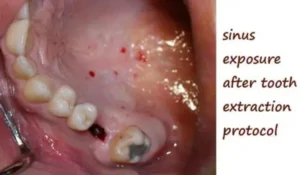
Sinus Perforation After Tooth Extraction
Quick Answer: What Is Sinus Perforation After Tooth Extraction?
Sinus perforation occurs when an opening forms between the oral cavity and the maxillary sinus during tooth extraction, most commonly with upper molars or premolars. Small perforations often heal naturally within 2-4 weeks, while larger openings may require surgical repair to prevent infection and ensure proper healing.
Understanding Sinus Perforation: What Chicago Patients Need to Know

Sinus Perforation
A sinus perforation (also called oroantral communication) creates an abnormal pathway between your mouth and the maxillary sinus cavity located above your upper jaw. This complication can occur during dental extraction, particularly when removing upper back teeth whose roots extend close to or into the sinus floor.
Many Chicago residents seeking tooth extraction at practices in Lincoln Park or Lakeview worry about this complication. While it sounds alarming, understanding the condition helps you recognize symptoms early and seek appropriate treatment.
The Anatomy Connection
Your maxillary sinuses are air-filled spaces in your cheekbones, positioned directly above the roots of your upper molars and premolars. In some patients, only a thin layer of bone—sometimes as thin as 1-2mm—separates these tooth roots from the sinus membrane. This close proximity makes perforation of maxillary sinus a recognized risk during dental procedures.
How Common Is Sinus Perforation After Tooth Extraction?
Sinus perforation is relatively uncommon but not rare. Research indicates that:
- Occurs in approximately 10-15% of upper molar extractions
- Higher incidence with wisdom tooth extraction (particularly upper wisdom teeth)
- More likely during extraction of teeth with periapical infections or bone loss
- Risk increases with age due to natural sinus expansion
At EliteFixDenture in Chicago, Dr. Aziz Liaquat emphasizes that while sinus perforation during tooth extraction is a known complication, experienced oral surgeons use advanced imaging and precise techniques to minimize this risk significantly.
Causes: Why Does Sinus Perforation Happen?
Several factors contribute to sinus perforation during tooth extraction:
1. Anatomical Factors
Thin bone structure: Some Chicago patients naturally have minimal bone separating their maxillary teeth from the sinus cavity. CT scans can reveal this before extraction.
Large sinus cavities: Sinuses that extend lower than average increase the risk of perforation.
Long or curved tooth roots: Teeth with roots that project into or toward the maxillary sinus are more prone to causing perforation during removal.
Sinus pneumatization: As we age, sinuses naturally expand, reducing the bone buffer between teeth and sinus floor.
2. Pre-Existing Conditions
Chronic sinus infections: Previous sinusitis can weaken the sinus membrane, making it more susceptible to perforation.
Periodontal disease: Advanced gum disease causes bone loss around teeth, reducing the protective barrier.
Previous dental surgeries: Past procedures may have thinned the bone or compromised sinus membrane integrity.
Dental infections: Abscesses or root canal infections near the sinus can create pathways for perforation.
3. Procedural Factors
Complex extractions: Impacted or severely decayed teeth may require more force, increasing perforation risk.
Surgical technique: Excessive force or improper instrument use can accidentally breach the sinus membrane.
Root tip displacement: During extraction, a root tip may be pushed into the sinus cavity, creating perforation.
Symptoms of Sinus Perforation After Tooth Extraction
Recognizing sinus perforation symptoms early is crucial for prompt treatment. Watch for these warning signs after upper tooth extraction:
Immediate Symptoms (During or Right After Extraction)
Air passage sensation: Feeling air move between your mouth and nose when you breathe, talk, or swallow. This is one of the most distinctive signs of sinus perforation.
Bubbling at extraction site: Visible bubbling of blood and saliva at the tooth socket when you breathe through your nose.
Whistling sound: Hearing air whistle through the extraction site during breathing or speaking—a clear indicator of perforation.
Fluid leakage: Liquids you drink may leak into your nose, causing an uncomfortable drainage sensation.
Delayed Symptoms (Hours to Days After)
Nasal congestion: Persistent stuffiness or pressure in your cheek and nose area.
Bloody nasal discharge: Blood-tinged or clear fluid draining from the nose on the side of the extraction.
Sinus pressure: Feeling of fullness, tightness, or discomfort in the maxillary sinus region under your eyes.
Bad breath or taste: Unpleasant odor or metallic taste indicating possible sinus perforation infection.
Prolonged bleeding: The extraction site continues oozing blood longer than typical healing would suggest.
Facial swelling: Mild to moderate swelling near the upper jaw or cheek area.
Warning Signs of Complications
Fever: Temperature above 100.4°F suggests developing sinus infection.
Severe pain: Escalating discomfort beyond normal post-extraction soreness.
Purulent discharge: Green or yellow discharge from nose or extraction site indicates infection.
Eye symptoms: Pain, pressure, or swelling around the eye requires immediate attention.
In some cases, untreated dental infections can form a channel connecting the oral cavity to the sinus, known as an intraoral dental sinus.
Diagnosis: How Dentists Detect Sinus Perforation
At EliteFixDenture in Chicago, Dr. Aziz Liaquat uses multiple diagnostic methods to confirm sinus perforation:
Clinical Examination
Visual inspection: Direct observation of the extraction site may reveal opening into the sinus cavity.
Valsalva maneuver: Patient gently attempts to blow air through closed nostrils—if air escapes from the extraction site, perforation is confirmed.
Mirror test: A dental mirror held near the extraction site may fog up from air escaping through perforation.
Imaging Studies
Periapical X-rays: Show the relationship between tooth roots and sinus floor, though they may miss small perforations.
Panoramic radiographs: Provide broader view of maxillary sinus and surrounding structures.
CBCT scans (Cone Beam CT): The gold standard for assessing sinus perforation, offering 3D visualization of the perforation size and exact location.
CT scans: May be ordered if sinusitis or other complications are suspected.
Functional Tests
Nasal test for sinus perforation: Patient pinches nose and tries to blow gently—air through extraction site confirms perforation.
Fluid test: Liquid in the mouth may drain into nose through the perforation.
Treatment for Sinus Perforation After Tooth Extraction
Treatment of sinus perforation depends on the size of the opening and timing of diagnosis:
Small Perforations (Under 5mm)
Conservative management is typically successful for minor perforations:
Immediate measures:
- Blood clot protection at extraction site
- Gentle suturing to approximate tissue edges
- Collagen plug for sinus perforation placement to support healing
- No packing to avoid infection risk
Medications:
- Antibiotics (typically Amoxicillin with Clavulanate for 7-10 days)
- Decongestants (Sudafed or similar to reduce sinus pressure)
- Pain management (Ibuprofen and/or acetaminophen)
- Nasal sprays if prescribed by your dentist
Sinus precautions:
- Avoid blowing your nose for 2-3 weeks
- Sneeze with mouth open to release pressure
- No straw use (suction can disrupt healing)
- Limit physical activity
- No swimming or diving
- Avoid air travel if possible
Medium Perforations (5-10mm)
Surgical closure may be necessary:
Primary closure of sinus perforation:
- Buccal advancement flap: Gum tissue from the cheek side is mobilized and sutured over the perforation
- Palatal rotation flap: Tissue from the roof of the mouth covers the opening
- Collagen membrane or gelatin sponge provides scaffolding for healing
Success rate: 85-95% when performed within 48 hours of extraction
Large Perforations (Over 10mm)
Complex surgical repair often required:
Advanced techniques:
- Buccal fat pad flap: Fat tissue from the cheek provides excellent coverage
- Bone grafting: Rebuilds the sinus floor structure
- Sinus lift surgery: May be combined with bone graft for future dental implant placement
- Primary closure of a sinus perforation with multiple tissue layers
These procedures may require referral to an oral surgeon or ENT specialist experienced in maxillary sinus perforation management.
Sinus Perforation Healing Time: What to Expect
How long does a sinus perforation take to heal? The answer depends on several factors:
Natural Healing Timeline
Small perforations (< 5mm):
- Initial clot formation: 24-48 hours
- Epithelialization begins: 5-7 days
- Complete closure: 2-4 weeks
- Full bone remodeling: 8-12 weeks
Medium perforations (5-10mm):
- With surgical repair: 4-6 weeks
- Tissue maturation: 2-3 months
Large perforations (> 10mm):
- Surgical healing: 6-8 weeks
- Complete recovery: 3-6 months
- Bone graft integration: 4-9 months
Factors Affecting Healing
Positive influences:
- Non-smoker status
- Good overall health
- Proper sinus perforation protocol adherence
- Early treatment intervention
- Excellent oral hygiene
Negative influences:
- Smoking (significantly delays healing)
- Sinus infection or sinusitis
- Diabetes or immunocompromised conditions
- Poor compliance with restrictions
- Bone fragments or root tip in sinus
Will a Sinus Perforation Heal on Its Own?
Can a sinus perforation heal on its own? Yes, but with important caveats:
Self-healing is possible when:
- Perforation is less than 5mm
- No infection is present
- Sinus membrane is healthy
- Patient follows all precautions
- Blood clot remains undisturbed
Self-healing is unlikely when:
- Opening exceeds 5-6mm in diameter
- Sinus infection develops
- Foreign material (root fragment, bone fragment) is present
- Perforation develops into oroantral fistula (permanent tract)
- Patient violates precautions (nose blowing, pressure changes)
Dr. Liaquat at EliteFixDenture advises Chicago patients: “While small perforations can heal naturally, professional monitoring is essential. What starts as a minor issue can become a chronic problem if ignored.”
Complications: When Sinus Perforation Becomes Serious
Untreated or improperly managed sinus perforation can lead to:
Acute Complications
Sinusitis: Bacterial infection of the maxillary sinus causing pain, fever, and purulent discharge.
Orbital cellulitis: Infection spreading to tissues around the eye—a medical emergency requiring immediate treatment.
Sepsis: In rare cases, sinus infection can spread systemically.
Chronic Complications
Oroantral fistula (OAF): Perforation that doesn’t close within 48-72 hours becomes a permanent pathway, resisting spontaneous closure.
Chronic sinusitis: Persistent sinus inflammation and infection cycles.
Aspergillosis: Fungal infection in the sinus cavity, particularly if foreign material remains.
Bone loss: Progressive deterioration of the maxillary bone structure.
Dental implant complications: Future dental implant placement becomes more complex or impossible without bone grafting.
Untreated sinus perforation can lead to chronic sinus infection, causing congestion, pressure, and discomfort.
Post-Operative Care: Sinus Perforation Protocol
Following sinus perforation post-op instructions is critical for successful healing:
First 48 Hours
Do:
- Apply ice packs (20 minutes on, 20 off)
- Keep head elevated while sleeping
- Take medications exactly as prescribed
- Eat soft, cool foods
- Maintain gentle oral hygiene (avoid extraction site)
- Rest and limit activity
Don’t:
- Blow your nose
- Use straws
- Smoke or use tobacco
- Spit forcefully
- Rinse vigorously
- Exercise or lift heavy objects
First 2 Weeks
Continue avoiding:
- Nose blowing (this is crucial)
- Creating suction in your mouth
- Sneezing with closed mouth
- Smoking
- Swimming or diving
- Air travel if possible
Add:
- Gentle salt water rinses (after 24 hours)
- Soft diet progression
- Normal brushing (away from site)
Weeks 2-4
Gradually resume:
- Normal diet (avoid popcorn, chips, seeds)
- Light exercise
- Regular activities
Continue monitoring for:
- Any unusual discharge
- Persistent sinus pressure
- Bad breath despite hygiene
- Delayed healing
Preventing Sinus Perforation: What Patients Should Know
While not all perforations are preventable, these steps reduce risk:
Before Extraction
Choose an experienced provider: Board-certified oral surgeons or experienced dentists have lower complication rates.
Get proper imaging: CBCT or CT scans reveal your unique anatomy and sinus position.
Disclose medical history: Inform your dentist about chronic sinusitis, previous surgeries, or bone conditions.
Treat infections first: Active dental or sinus infections should be resolved before elective extractions.
During Procedure
Gentle extraction technique: Sectioning multi-rooted teeth reduces force and perforation risk.
Controlled force: Experienced surgeons avoid excessive pressure that could breach the sinus.
Immediate recognition: If perforation occurs, immediate treatment improves outcomes significantly.
Sinus Perforation and Dental Implants
Many Chicago patients wonder: Can I get a dental implant after sinus perforation?
Timeline for Implant Placement
After successful healing:
- Wait minimum 3-6 months after perforation closure
- Bone graft sites need 4-9 months to integrate
- CBCT scan confirms adequate bone height and density
Sinus lift with implant:
- If bone loss occurred, sinus augmentation rebuilds the sinus floor
- Simultaneous implant placement may be possible with sufficient remaining bone
- Staged approach separates bone grafting from implant placement
Dr. Aziz Liaquat specializes in implant dentistry and has extensive experience managing sinus perforation cases before implant placement. His approach ensures optimal bone health and implant success for Chicago patients.
When to Seek Emergency Care
Contact your dentist or visit an ER if you experience:
- High fever (above 101°F)
- Severe, worsening pain not controlled by medication
- Vision changes or eye swelling
- Difficulty breathing
- Excessive bleeding that won’t stop
- Signs of allergic reaction to medications
- Confusion or altered consciousness
Cost Considerations: Sinus Perforation Repair in Chicago
Sinus perforation repair cost varies significantly based on complexity:
| Treatment Type | Estimated Cost Range |
|---|---|
| Conservative management | $200 – $500 |
| Primary closure (simple) | $800 – $1,500 |
| Surgical repair with flap | $1,500 – $3,500 |
| Bone grafting | $500 – $2,000 per area |
| Sinus lift surgery | $1,500 – $4,000 |
| ENT specialist consultation | $300 – $600 |
Insurance coverage:
- Most dental insurance covers medically necessary sinus perforation treatment
- May be classified as oral surgery complication
- Check with your Chicago-area insurance provider
- Medical insurance may cover ENT treatment of sinusitis complications
EliteFixDenture works with patients to maximize insurance benefits and offers flexible payment options for Chicago residents.
Real Patient Experience: A Chicago Story
“I had my upper molar extracted and didn’t realize anything was wrong until liquid came out of my nose while drinking water that evening,” shares Maria, a 52-year-old Lakeview resident. “I called EliteFixDenture immediately, and Dr. Liaquat saw me first thing the next morning. He confirmed the sinus perforation, prescribed antibiotics, and gave me detailed instructions. I followed everything exactly—no nose blowing, sleeping elevated, the whole protocol. My perforation healed completely in three weeks without needing surgery.”
Maria’s experience highlights the importance of early recognition and proper management. Not all patients are this fortunate, but prompt professional care significantly improves outcomes.
Special Considerations: Wisdom Tooth Sinus Perforation
Wisdom tooth extraction sinus perforation presents unique challenges:
Why wisdom teeth are different:
- Upper wisdom teeth roots often extend closest to sinus floor
- Frequently impacted, requiring more surgical manipulation
- Bone around wisdom teeth may be thinner
- Sinus anatomy varies more in this region
Prevention strategies:
- Pre-operative CBCT imaging is essential
- Surgical tooth sectioning reduces force
- Consider staged extraction if anatomy is concerning
- Referral to oral surgeon for high-risk cases
Sinus Perforation vs. Dry Socket: Key Differences
Chicago patients sometimes confuse these complications:
| Feature | Sinus Perforation | Dry Socket |
|---|---|---|
| Timing | Immediate or within hours | 3-5 days post-extraction |
| Main symptom | Air/fluid passage to nose | Severe throbbing pain |
| Cause | Anatomical breach | Blood clot loss |
| Treatment | Possible surgery | Medicated dressing |
| Location | Upper back teeth | Any tooth |
| Severity | Varies widely | Moderate to severe |
Advanced Topics: Root Canal and Sinus Perforation
Root canal sinus perforation can occur during endodontic therapy:
Why it happens:
- Filing instruments penetrate through root apex into sinus
- Existing perforation from previous trauma
- Overextension of filling materials
Symptoms:
- Similar to extraction perforation
- May include persistent sinus drainage
- Headaches on affected side
Treatment:
- Apicoectomy (surgical root tip removal)
- Sinus perforation repair if indicated
- Sometimes tooth extraction and implant become necessary
Research and Evidence: What Studies Show
Recent scientific literature on sinus perforation reveals:
Incidence rates:
- A 2023 study found 12% incidence in upper molar extractions
- Wisdom tooth extractions show 15-20% rate
- Under-reporting likely means actual rates are higher
Healing outcomes:
- 90% of perforations under 5mm close spontaneously
- Early surgical intervention has 95% success rate
- Delayed treatment reduces success to 70-80%
Complication factors:
- Smoking increases infection risk by 300%
- Diabetes doubles healing time
- Age over 60 associated with larger natural sinus cavities
FAQs: Your Sinus Perforation Questions Answered
1. How do I know if I have a sinus perforation after tooth extraction?
Key signs include air or fluid passing between your mouth and nose, whistling sounds when breathing, nasal congestion, liquid leaking into your nose when drinking, and persistent sinus pressure. If you experience any of these symptoms of sinus perforation after tooth extraction, contact your dentist immediately. The Valsalva maneuver (gently trying to blow air through closed nostrils) can reveal perforation if air escapes through the extraction site.
2. Can I blow my nose with a sinus perforation?
Absolutely not. Blowing your nose after tooth extraction with sinus perforation is one of the worst things you can do. It increases sinus pressure, can enlarge the perforation, dislodge protective blood clots, and push bacteria into the sinus cavity, leading to infection. Chicago patients at EliteFixDenture are instructed to avoid nose blowing for at least 2-3 weeks, even if no perforation is suspected. If you must sneeze, do so with your mouth open.
3. How long does sinus perforation healing take?
Healing time depends on perforation size and treatment. Small perforations (under 5mm) typically heal in 2-4 weeks with conservative care. Medium perforations (5-10mm) requiring surgical closure need 4-6 weeks. Large perforations (over 10mm) may take 6-8 weeks or longer. Complete bone remodeling continues for 3-6 months. Following your dentist’s sinus perforation protocol exactly is crucial for optimal healing time.
4. Will a sinus perforation heal on its own without treatment?
Small sinus perforations (under 5mm) can heal on their own if you follow strict precautions: no nose blowing, sneezing with mouth open, avoiding straws, no smoking, and limited physical activity. However, medical supervision is essential. Perforations over 5mm rarely close spontaneously and typically require surgical intervention. If a perforation doesn’t heal within 48-72 hours, it may develop into an oroantral fistula, a permanent pathway requiring surgical closure. Never assume a perforation will heal without professional evaluation.
5. What happens if sinus perforation is left untreated?
Untreated sinus perforation can lead to serious complications: chronic sinusitis, oroantral fistula formation (permanent opening), recurrent sinus infections, fungal infections (especially with foreign material in sinus), bone loss in the jaw, difficulty with future dental implants, and rarely, infection spreading to the eye or brain. Dr. Liaquat at EliteFixDenture emphasizes that Chicago patients should never ignore sinus perforation symptoms—early treatment prevents these serious outcomes.
6. Can I get dental implants after a sinus perforation?
Yes, dental implant placement is definitely possible after sinus perforation, but timing is critical. You must wait for complete healing—typically 3-6 months after successful perforation closure. If bone loss occurred, you’ll need sinus augmentation or bone grafting first, adding another 4-9 months. Dr. Aziz Liaquat, our implant dentistry specialist at EliteFixDenture in Chicago, uses CBCT imaging to assess bone quality and plan optimal implant placement. Many patients ultimately achieve excellent implant success despite previous perforation.
7. Is sinus perforation during tooth extraction malpractice?
No, sinus perforation is a recognized complication of upper tooth extraction, not necessarily malpractice. Malpractice occurs only if: the dentist failed to obtain proper informed consent, didn’t use appropriate diagnostic imaging when indicated, failed to recognize and treat the perforation promptly, or provided substandard care that worsened outcomes. Experienced Chicago dentists like Dr. Liaquat take every precaution, but anatomy sometimes makes perforation unavoidable. What matters is proper diagnosis, immediate treatment, and appropriate follow-up care.
8. What’s the difference between sinus perforation and oroantral fistula?
A sinus perforation is an acute opening created during dental extraction or surgery. An oroantral fistula (OAF) is a chronic, epithelialized tract that develops when a perforation doesn’t heal within 48-72 hours. Perforations can heal naturally; fistulas require surgical closure as they’re essentially permanent openings. The key difference is timing and chronicity—early treatment of perforation prevents fistula formation. OAF typically requires more complex surgical repair with tissue flaps or grafts.
9. Can I fly with a sinus perforation after tooth extraction?
Avoid flying for at least 2-3 weeks after tooth extraction if sinus perforation is suspected or confirmed. Air pressure changes during takeoff and landing create significant sinus pressure fluctuations that can: enlarge the perforation, disrupt healing tissues, dislodge protective blood clots, cause severe pain, and trigger bleeding. If you must fly, consult your dentist first. Chicago patients traveling for work should plan dental procedures accordingly. Emergency travel may require special precautions like decongestants and careful pressure equalization techniques.
Conclusion: Expert Sinus Perforation Care in Chicago
Sinus perforation after tooth extraction is a manageable complication when recognized and treated promptly. While it can feel alarming, most Chicago patients experience complete healing with proper care and precautions.
The keys to successful sinus perforation recovery are:
- Early recognition of symptoms
- Immediate professional evaluation
- Strict adherence to post-operative precautions
- Appropriate treatment based on perforation size
- Patient monitoring throughout healing
Whether you’re facing upper molar extraction, need dental implant placement, or are dealing with wisdom tooth removal, choosing an experienced provider makes all the difference.
Take the Next Step: Protect Your Oral and Sinus Health
If you’re scheduled for tooth extraction or experiencing symptoms of sinus perforation, contact EliteFixDenture in Chicago today. Our team combines advanced diagnostic imaging, precise surgical techniques, and comprehensive patient care to minimize complications and optimize healing.
Your oral health deserves expert attention—especially when procedures involve the delicate relationship between your teeth and sinuses.
Disclaimer
This article is for informational purposes only and not a substitute for professional dental advice, diagnosis, or treatment. Always seek the advice of your dentist or other qualified healthcare provider with any questions about sinus perforation, tooth extraction, or your oral health.
Expert Care You Can Trust
Reviewed by Dr. Aziz Liaquat, DDS
Specialist in Implant Dentistry
EliteFixDenture, Chicago, Illinois
Dr. Liaquat brings over 15 years of experience managing complex dental extractions, sinus complications, and dental implant placement. His expertise in maxillary sinus anatomy and commitment to patient-centered care ensures Chicago residents receive the highest standard of treatment.
Call to Action: Concerned about sinus perforation or need expert tooth extraction with advanced precautions? Schedule your consultation with Dr. Aziz Liaquat at EliteFixDenture.com or call our Chicago office today.