DENTAL IMPLANTS COST IN THE USA
2026 Complete Guide: Every Cost Explained, What Affects Price, Insurance, Financing & How to Save
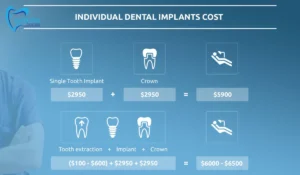
| 💰 Single Implant $3,000 – $6,000 | 💰 Implant + Crown $1,500 – $3,000 avg. | 💰 Full Mouth $20,000 – $90,000 | 💰 All-on-4 $12,000 – $25,000/arch |
What Does a Dental Implant Actually Cost in 2026?
The most important thing to understand about dental implant cost in the USA is that there is no single price. The total cost of a dental implant depends on how many teeth you are replacing, where you live, what additional procedures are needed, which type of implant is used, and who performs the procedure.
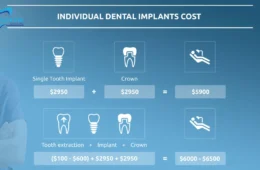
The frequently cited figure of ‘$3,000–$6,000 per tooth’ refers to a complete single-tooth implant — including the titanium post, the abutment connector, and the porcelain crown. That is the all-in cost for one tooth in an average US market. But patients with bone loss need grafting. Patients replacing a full arch need entirely different solutions. And patients in New York City will pay nearly double what patients in rural Arizona pay for identical procedures.
This guide breaks down every component cost, explains every factor that drives price up or down, covers every payment option available to US patients in 2026, and gives you the honest information you need to have an informed conversation with your dentist — without being oversold.
| 📌 | All cost ranges in this guide reflect 2025–2026 US market data based on ADA dental fee surveys, insurance industry reports, and published dental school fee schedules. Individual quotes from your provider will vary. Get at least two to three quotes before committing to any implant treatment. |
Complete Dental Implant Cost Breakdown — Every Line Item
A dental implant is not a single item — it is a multi-step treatment involving several components, often multiple providers, and sometimes prerequisite procedures. Here is every cost you may encounter:
| Treatment Type | Low End (USA) | High End (USA) |
| Single dental implant (implant post only) | $1,500 | $3,000 |
| Implant crown (porcelain) | $1,000 | $3,000 |
| Abutment (connector piece) | $300 | $800 |
| Full single-tooth implant (all-inclusive) | $3,000 | $6,000 |
| Bone graft (if needed) | $300 | $3,000 |
| Sinus lift (if needed) | $1,500 | $5,000 |
| Tooth extraction (before implant) | $150 | $650 |
| Implant-supported bridge (3 teeth) | $5,000 | $16,000 |
| Implant denture / snap-on denture (per arch) | $3,500 | $30,000 |
| All-on-4 dental implants (per arch) | $12,000 | $25,000 |
| All-on-6 dental implants (per arch) | $15,000 | $28,000 |
| Full mouth dental implants (both arches) | $34,000 | $90,000 |
| Mini dental implants (per implant) | $500 | $1,500 |
| ⚠️ | The single most common reason patients are shocked by dental implant costs is hidden line items — bone grafts, sinus lifts, extractions, and multiple appointments that were not clearly outlined upfront. Always ask for a complete itemized treatment plan in writing before starting. Request the code for each procedure (CDT code) so you can verify insurance coverage independently. |
9 Factors That Affect Dental Implant Cost in the USA
Understanding what drives dental implant prices helps you evaluate quotes intelligently and identify where savings are genuinely possible vs. where cutting costs compromises quality.
| Cost Factor | How It Affects Price |
| Geographic location | Prices in NYC can be 2–3× higher than rural Midwest or Southeast |
| Implant brand | Premium brands (Nobel Biocare, Straumann) cost more than generic/house brands |
| Dentist vs. oral surgeon vs. periodontist | Specialists typically charge higher fees but handle complex cases |
| Bone density and graft need | Poor bone requires a graft ($300–$3,000) before implant placement |
| Sinus proximity (upper back teeth) | Sinus lift procedure adds $1,500–$5,000 to upper molar implants |
| Number of teeth being replaced | More implants = more cost but often better per-unit pricing |
| Type of restoration | Individual crown vs. implant-supported bridge vs. full arch differ widely |
| Sedation type | IV sedation adds $500–$1,000 vs. local anesthesia alone |
| Number of office visits | Simple cases require fewer visits; complex staged treatment costs more |
The Bone Graft Question: A Major Hidden Cost
Bone grafting is the single most common and most expensive unexpected cost in dental implant treatment. When a tooth is lost or extracted, the jawbone at that site begins to resorb (shrink) within weeks. If implant placement is delayed, or if the tooth was lost due to infection or periodontal disease, there may not be enough bone volume or density to support an implant without first building it back up.
- Minor bone graft (socket preservation at time of extraction): $300 – $800
- Localized block graft: $1,000 – $3,000
- Sinus augmentation / sinus lift (upper back teeth): $1,500 – $5,000
- Full ridge augmentation: $2,000 – $5,000
Not every patient needs a bone graft — a CBCT (cone beam CT) scan taken during your implant consultation will show your bone volume and density precisely. If you are told you need a bone graft without imaging, request one before agreeing to the procedure.
Dental Implant Cost by City and State (USA 2026)
Geographic location is one of the biggest determinants of dental implant cost in the United States. Dentists in high cost-of-living cities charge proportionally more — for the same procedure, the same implant brand, and comparable skill levels. Here is the honest breakdown by US market:
| Location | Single Implant Cost | Notes |
| New York City, NY | $4,500 – $7,000 | Most expensive market in USA |
| Los Angeles / San Francisco, CA | $4,000 – $6,500 | High cost of living region |
| Chicago, IL | $3,500 – $5,500 | Above-average Midwest pricing |
| Houston / Dallas, TX | $2,800 – $5,000 | Mid-range — competitive market |
| Miami, FL | $3,000 – $5,500 | Popular dental tourism hub |
| Phoenix, AZ | $2,500 – $4,500 | Below-average USA pricing |
| Denver, CO | $3,000 – $5,000 | Mid-range market |
| Rural / Small-town USA | $2,000 – $4,000 | Lowest US pricing generally |
| Mexico border cities (Tijuana, Nogales) | $900 – $2,000 | Dental tourism — significant savings |
| 💡 | Patients in high-cost markets (NYC, LA, SF) can sometimes save 30–40% by traveling to a lower-cost major city for their implant procedure. This is different from international dental tourism and eliminates concerns about follow-up care. Compare the travel cost against the savings — for full-arch cases, the math often strongly favors traveling domestically. |
Types of Dental Implants and What Each Costs
Not all dental implants are the same solution. Different types of implants are appropriate for different clinical situations — and their costs vary dramatically. Here is a clear comparison:
| Implant Type | Avg. US Cost | How It Works | Best For |
| Endosteal (standard titanium screw) | $3,000–$6,000 | Most common; titanium fuses to bone | Best for most adults with adequate bone |
| All-on-4 / All-on-6 | $12,000–$28,000/arch | 4 or 6 implants support full arch denture | Full-arch tooth loss; efficient solution |
| Mini implants | $500–$1,500 each | Smaller diameter; less invasive | Narrow bone ridges; lower jaw dentures |
| Zygomatic implants | $15,000–$30,000/arch | Anchored in cheekbone, not jaw | Severe upper jaw bone loss |
| Implant-supported bridge | $5,000–$16,000 | 2 implants support 3–4 crown bridge | Missing consecutive teeth |
| Implant-supported denture | $3,500–$30,000/arch | Snap-on removable over implants | Edentulous patients wanting removable option |
All-on-4 vs All-on-6 vs Full Mouth Implants: What Is the Difference?
All-on-4: Four implants per arch support a fixed full-arch prosthesis (a set of teeth). The strategic angulation of the posterior implants allows placement in areas of natural bone density, often eliminating the need for bone grafting. Cost: $12,000 – $25,000 per arch.
All-on-6: Six implants per arch for greater stability and load distribution. Preferred when bone density allows and for more demanding biting forces. Cost: $15,000 – $28,000 per arch.
Full mouth implants (individual): Replacing each missing tooth with its own implant and crown — the most stable and longest-lasting option but the most expensive at $34,000 – $90,000 for a full mouth.
Implant-supported denture (snap-in): A removable denture that snaps onto 2–4 implants for retention. Lower cost than fixed solutions, less stable than All-on-4. Cost: $3,500 – $30,000 per arch depending on implant count and denture quality.
Does Insurance Cover Dental Implants? Every Payment Option Explained
The most-searched question among dental implant patients is whether insurance covers the cost. The honest answer in 2026: some plans cover parts of the treatment, most do not cover the implant post itself, and the coverage landscape is slowly improving. Here is every realistic payment option for US patients:
| Payment Option | What You Need to Know |
| Dental insurance (PPO) | May cover crown/abutment portion ($1,000–$2,000 lifetime max); rarely covers the titanium implant post itself. Some newer plans specifically include implants — check your policy. |
| FSA / HSA | Both qualify as medical expenses. Using pre-tax dollars saves 20–30% depending on your tax bracket. One of the most overlooked cost-reduction strategies. |
| CareCredit | Dental financing credit card. Offers 6–24 months 0% promotional APR for qualifying purchases. Deferred interest applies if balance is not paid by end of promotional period. |
| In-house payment plans | Many dental offices offer 0% in-house installments, typically 12–36 months. No hard credit pull at many practices. |
| Dental schools | University dental school clinics offer implants at 40–60% below private practice rates, placed by supervised dental students and residents. Quality is generally high; treatment takes longer. |
| Dental discount plans | Membership plans (e.g., Careington, DentalPlans.com) offer 15–50% discounts at participating dentists. Not insurance — a negotiated fee schedule. Useful for uninsured patients. |
| Medical insurance | Rarely covers implants. Exceptions: implants needed following oral cancer treatment, trauma, or in cases where tooth loss is medically documented as affecting systemic health. |
| Veterans benefits (VA) | Eligible veterans may receive dental implants through the VA dental program. Eligibility is based on service-connected conditions and other qualifying criteria. |
| Dental tourism (Mexico, Costa Rica) | Patients traveling to border cities or dental tourism destinations can save 50–70% on implant costs. Quality varies significantly by provider. Research credentials carefully. |
How to Maximize Insurance Coverage for Dental Implants
- Request pre-authorization before treatment begins — your insurer will confirm exactly what is covered and at what percentage, in writing, before you spend a dollar
- Ask your dentist to bill the crown and abutment separately from the implant post — some plans cover restorative work (the crown) even when they exclude the surgical implant
- If your plan renews annually, consider staging treatment across two calendar years to use two annual maximums — place the implant in December, place the crown in January
- Verify whether your plan covers the implant under medical vs. dental benefits — implants for medically necessary tooth replacement (trauma, cancer treatment) may fall under medical insurance
- Check your employer’s open enrollment — some employers offer supplemental dental plans with implant benefits; switching plans ahead of treatment can save thousands
Dental Implants vs. Alternatives: Is the Cost Worth It?
Dental implants are the most expensive tooth replacement option — but cost comparisons over a lifetime often tell a different story. Here is how implants compare to alternatives:
Dental bridge: $2,500 – $6,000 for a 3-unit bridge. Lower upfront cost than an implant. However, bridges require grinding down healthy adjacent teeth for crowns, last 10–15 years on average, and do not prevent jawbone loss. Replacement cost over 30 years exceeds an implant’s one-time cost in most cases.
Removable partial denture: $1,000 – $3,000. Lowest upfront cost but least comfortable and least functional solution. Does not prevent bone loss. Requires replacement every 5–8 years as the jaw ridge changes shape. Many patients abandon partial dentures within a year.
Full denture: $1,500 – $5,000. Traditional full dentures rest on the gum ridge. Bone resorption continues underneath, causing the denture to loosen over time. Requires relines, remakes, and adhesives. Implant-supported options dramatically improve stability and long-term outcomes.
Dental implant: $3,000 – $6,000 upfront. No grinding of adjacent teeth. Prevents jawbone loss. Success rate of 95–98% at 10 years in good candidates. Expected lifespan with proper maintenance: 20–30+ years. The only tooth replacement option that preserves jawbone structure.
| ✅ | Over a 25–30 year horizon, dental implants are frequently the most cost-effective tooth replacement option when total treatment, maintenance, and replacement costs are factored in. The high upfront cost is real — but so is the long-term value. This comparison is most meaningful for patients under 65 with many years ahead of them. |
Cheap Dental Implants: What Are the Risks?
Online ads and discount dental centers sometimes advertise implants for $1,000 or even $799 per tooth. Understanding what drives those prices — and what risks they carry — is essential before pursuing cut-rate implant options.
What Cheap Implants Often Mean
- Generic or house-brand implant systems: No-name implants with limited peer-reviewed research, no established long-term failure data, and often no replacement parts available if the implant needs revision years later
- Less experienced providers: Lower fees often reflect newer providers building their case volume or general dentists rather than specialists performing complex implant surgery
- Excluded components: ‘$799 implants’ often exclude the abutment, the crown, bone grafting, imaging, and anesthesia — the true all-in cost may match or exceed standard pricing
- Compromised materials: Titanium purity, surface treatment, and implant geometry all affect osseointegration success rates. These differences are invisible to the patient but clinically significant
Dental Tourism: Realistic Assessment
Dental tourism to Mexico (Tijuana, Los Algodones, Cancun), Costa Rica, and other destinations is genuinely popular among US border-state patients, and the cost savings can be substantial — 50 to 70% less for equivalent procedures at reputable clinics. The real risks are:
- Follow-up complications: If the implant fails or requires revision, returning for treatment adds cost and inconvenience that erodes the original savings
- Quality variability: Some dental tourism clinics use the same premium brands (Nobel Biocare, Straumann) as US clinics; others use unverified generic systems. Ask specifically which implant brand and model will be used
- No recourse: If something goes wrong, US consumer protection laws do not apply to treatment received abroad
| ❌ | Avoid any dental implant provider who cannot or will not tell you: (1) the brand and model of the implant system being used, (2) their personal implant placement complication rate, and (3) what happens and who pays if the implant fails. Legitimate providers answer all three questions without hesitation. |
Who Is a Good Candidate for Dental Implants?
Not every patient is immediately ready for dental implants. Understanding candidacy factors can help you anticipate whether additional treatment will be needed before implant placement — and what that adds to the total cost.
Good Candidates
- Adults with fully developed jaws (typically 18+ for women, 21+ for men)
- Adequate bone density and volume at the implant site — or willingness to undergo bone grafting
- Healthy gum tissue without active periodontal disease
- Non-smokers or willing to quit — smoking significantly reduces osseointegration success rates
- Controlled systemic health: well-managed diabetes, no active cancer treatment, no recent bisphosphonate use
Factors That Complicate Candidacy
- Uncontrolled diabetes: elevated blood sugar impairs healing and increases infection risk — implants can proceed when diabetes is well-managed
- Smoking: doubles the implant failure rate; most implant dentists strongly recommend quitting at least 2 weeks before and 8 weeks after surgery
- Bisphosphonate medications (Fosamax, Boniva, Zometa): these bone-density drugs can cause osteonecrosis (bone death) at implant sites — especially IV bisphosphonates used for cancer treatment
- Active periodontal disease: must be fully treated and controlled before implant placement
- Autoimmune disorders and immunosuppressant medications: increase infection and healing complications
- Heavy bruxism (teeth grinding): significantly increases implant crown and prosthesis fracture rates without a protective night guard
| 💡 | A cone beam CT (CBCT) scan — a 3D X-ray of your jaw — is the standard diagnostic tool for implant planning. It reveals exact bone dimensions, density, nerve locations, and sinus proximity. This scan ($150–$500 if not included in the consultation) should be performed before any implant treatment plan is finalized. Be cautious of any provider who plans implants based on 2D X-rays alone for complex cases. |
10 Legitimate Ways to Reduce Dental Implant Costs in 2026
- Get multiple quotes — prices for identical procedures vary 30–50% between practices in the same city. Three quotes minimum is standard advice.
- Use a dental school — university dental school clinics offer 40–60% discounts with supervised dental students and residents. Quality is generally excellent; treatment takes longer.
- Use your FSA or HSA — both are pre-tax accounts that effectively reduce your cost by your marginal tax rate (20–37% for most Americans). Maximize your contribution in the year you have implant treatment.
- Stage treatment across two calendar years to use two annual insurance maximums — timing matters for patients with dental insurance.
- Ask about implant-supported bridges vs. individual implants — replacing three consecutive missing teeth with a 2-implant bridge costs less than three individual implants.
- Choose an implant-supported denture over All-on-4 if budget is the primary concern and some removability is acceptable — lower upfront cost with meaningful stability improvement over a traditional denture.
- Ask about 0% in-house financing — many implant centers offer 12–24 month interest-free payment plans with no hard credit inquiry.
- Consider domestic travel to a lower-cost market — a trip from NYC to Phoenix for a full-arch case can save $8,000–$15,000, easily justifying travel costs.
- Socket preservation at extraction time — if you know you will eventually want an implant, ask for socket preservation grafting at the time of extraction. Preventing bone loss costs $300–$800 vs. $1,500–$3,000 for a later bone graft.
- Ask about implant brand options — premium brands (Nobel Biocare, Straumann, Zimmer Biomet) have the most long-term data. Established value brands (BioHorizons, Implant Direct) offer good evidence at lower cost. Ask your provider what they use and why.
Frequently Asked Questions — Dental Implant Cost USA 2026
Q: How much does one dental implant cost in the USA in 2026?
A: A complete single-tooth dental implant — including the titanium post, abutment, and porcelain crown — costs $3,000 to $6,000 on average in the USA in 2026. Lower-cost markets (rural areas, dental schools) can be $2,000–$3,500; high-cost urban markets (NYC, SF) run $5,000–$7,500. If bone grafting is needed, add $300–$3,000 to those figures.
Q: Does dental insurance cover implants in 2026?
A: Most traditional PPO dental insurance plans do not cover the titanium implant post but may cover the crown and abutment portions — typically at 50% of allowable costs up to the annual maximum ($1,000–$2,000/year). Newer enhanced dental plans sometimes include implant coverage explicitly. Always verify coverage in writing via pre-authorization before beginning treatment. HSA and FSA accounts can be used for any implant costs and offer significant tax savings.
Q: How much does All-on-4 cost in the USA?
A: All-on-4 dental implants (a full arch of fixed teeth supported by 4 implants) cost $12,000 to $25,000 per arch in the USA in 2026. Both arches (upper and lower) cost $24,000 to $50,000. Prices vary by location, provider, and whether bone grafting is needed. Some practices advertise lower ‘starting from’ prices that exclude final prosthetics — always ask for an all-inclusive treatment cost.
Q: What is the cheapest way to get dental implants in the USA?
A: The most cost-effective legitimate options are: (1) Dental school clinics — 40–60% below private practice rates; (2) FSA/HSA pre-tax funding — saves 20–37% depending on tax bracket; (3) Dental discount plans for uninsured patients; (4) Domestic dental tourism to lower-cost markets. Cheap implant offers below $1,500 complete should be investigated carefully — ask for full itemization and implant brand details.
Q: How long do dental implants last?
A: Dental implants have a clinical success rate of 95–98% at 10 years in good candidates according to systematic reviews in the Journal of Dental Research and similar publications. With proper oral hygiene and maintenance, the titanium implant post itself can last a lifetime. The crown on top typically lasts 15–25 years before needing replacement due to normal wear.
Q: Are dental implants worth the cost?
A: For most patients who are good candidates, dental implants are worth the investment when viewed over a 20–30 year horizon. They are the only tooth replacement option that prevents jawbone resorption, requires no modification of adjacent teeth, and functions with the same comfort and bite force as natural teeth. The total lifetime cost of implants is frequently lower than repeated replacement of bridges or dentures — and quality of life data consistently favors implants over other options.
Q: How much does a full mouth of dental implants cost?
A: Full mouth dental implants replacing all teeth individually cost $34,000 to $90,000 depending on teeth count, bone grafting needs, and location. All-on-4 or All-on-6 solutions are a more affordable full-arch alternative at $24,000 to $56,000 for both arches. Implant-supported dentures are the most affordable full-arch option at $7,000 to $60,000 for both arches depending on implant count and denture quality.
Q: What questions should I ask my dentist about implant costs?
A: Before agreeing to any implant treatment: (1) What is the complete all-inclusive cost including imaging, grafting, extraction, abutment, and crown? (2) What implant brand and model will you use? (3) What is your personal implant placement complication rate? (4) What happens and who covers the cost if the implant fails? (5) Is this procedure covered under my dental or medical insurance? (6) Do you offer in-house financing? (7) Are you a specialist (oral surgeon, periodontist) or a general dentist?
Summary: What to Expect When Budgeting for Dental Implants in 2026
Dental implant costs in the USA in 2026 range from $2,000 for a simple single implant at a dental school to $90,000+ for full-mouth reconstruction in a premium market. The most important things to take away from this guide:
- A single complete implant (post + abutment + crown) costs $3,000–$6,000 on average nationally
- Bone grafting, sinus lifts, extractions, and sedation are common add-ons that significantly increase total cost — always request an itemized treatment plan
- Location matters enormously — prices in New York can be 2–3× higher than rural or Southwest markets
- Most dental insurance covers the crown portion but not the implant post; HSA/FSA pre-tax funding is the most underused cost-reduction tool
- Dental schools offer the same procedures at 40–60% less — a legitimate, high-quality cost reduction option
- All-on-4 and All-on-6 are the most efficient full-arch solutions; individual full-mouth implants offer superior stability at significantly higher cost
- Cheap implant deals below $1,500 complete should be investigated carefully — full itemization and brand verification are essential
The best next step: schedule a consultation with a board-certified oral surgeon or periodontist who includes a CBCT scan and provides a written itemized treatment plan. Compare two to three quotes. Verify insurance coverage via pre-authorization. Use HSA or FSA dollars where available. With informed preparation, dental implants are a predictable, well-understood investment in long-term oral health.
| ✅ | Dental implants are the gold standard of tooth replacement for a reason — their success rates, longevity, and quality-of-life outcomes are unmatched by any alternative. The cost is real and significant. So is the value. An informed patient who understands every line item, explores every payment option, and selects a qualified provider makes the best possible decision for their situation. |
Editorial Disclaimer
This article is for informational purposes only and does not constitute dental or financial advice. Cost ranges reflect 2025–2026 US market data and will vary by location, provider, case complexity, and individual clinical factors. This content is not affiliated with, sponsored by, or compensated by any dental product manufacturer, dental practice, or insurance company. Always consult a licensed dental professional for a diagnosis and personalized treatment plan.
Medically reviewed by:
Dr. Aziz Liaquat, DDS
Doctor of Dental Surgery
New York University College of Dentistry